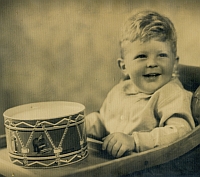
Martin Woodhouse's youth
Its Martin Woodhouse again, and according to the Sunday Times of London, I am an eccentric Englishman.
When the One Laptop Per Child project was announced I thought, as I am sure we all did, that Information Technology had come of age; that it had moved from being a bright teenager to an adulthood where wisdom and love are added to cleverness. That hasn't quite happened yet, but it can still do so.
The OLPC XO, for instance, needs similarly to move from mere brilliance -- it is, I repeat, brilliant in design, just as OLPC is gorgeous in kindliness and concept -- to maturity. It needs to do the job it is meant to serve: to educate the world's illiterate, and therefore unempowered, poor.
Now before designing anything, it's always wise to consider its purpose, sometimes very carefully indeed. We have set down that purpose, and we need, accordingly, to ask what it is that a person needs in order to move from illiteracy to education? (As, I remind you, each one of us has done while we were ourselves growing from infancy, through childhood, to being an adult person. We are just proposing to allow every person in the world the same opportunity; that is all.)
If we look at this carefully, we'll find that there is only one skill which we need to offer. It's that of being able to read, and nothing else. Notice that I use the word 'need', here, in the sense of being essential. Everything else, we can see, is optional. Writing, listening to sound, video recording, taking photographs -- everything else -- may be a convenience, even perhaps a great convenience, but it is not absolutely essential to everyone, as the ability to read is. A writer needs to be able to write, certainly, as an artist needs to draw or take photographs and a musician needs to make and to hear music; but everyone needs to be able to read, and to be provided with reading material.

OLPC XO only an e-book?
What every child (and adult) in the world needs, therefore, is simply a means of having words, and pictures, presented upon a flat surface in front of his or her eyes. That is all it takes to go from illiteracy all the way to university-level education. And it is all, therefore, we need to give them. In other words, an e-book reader.
Plus, of course, a supply of e-books by the hundred or the thousand; the OLPC Alexandrian Library we have seen mentioned here now and again. The 'laptop' given to every child needs to be an e-book reader capable of accessing that library. Not a PC, though of course the laptop computer is a highly desirable, and entirely sensible, next step. I am by no means suggesting that we should forget about it, merely that we need (they need) a cheap, simple -- and above all low-powered -- book reader first.
This makes our design problems a great deal easier. A very great deal easier indeed, as we shall now see. Such an e-book reader can be constructed from the following components and at these roughly estimated costs, many of which are taken from elsewhere in this site:
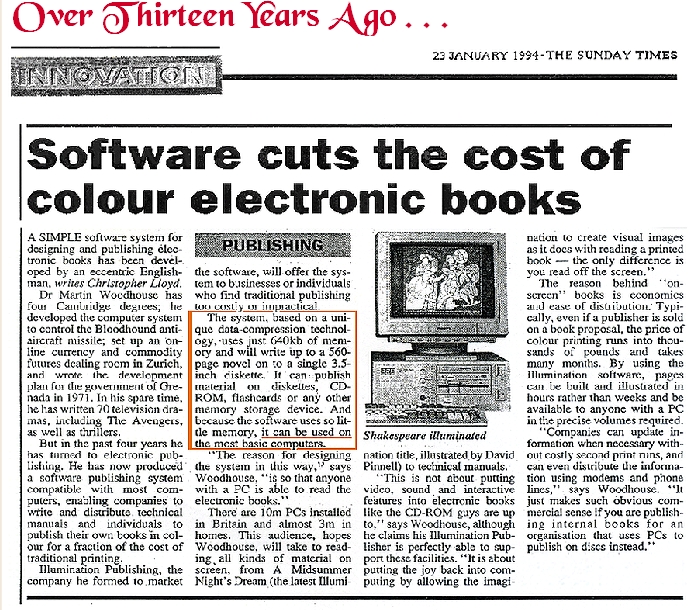
Thirteen years ago...
The operating system will be free (freeDOS will do nicely unless the lads and lasses want to write a VERY VERY SIMPLE ONE in Linux) and the e-book-reading software will be supplied with the e-books themselves, so we don't need an inbuilt user interface like Sugar, just a terribly easy way of choosing and loading a book.
So fifty dollars looks like being about okay. Have I forgotten anything? It's possible, but if so, I am sure that you will all let me know!
Now we get to the really nice bits. The machine will I suggest be called NOSH, standing for "NO SH*T fifty dollars is it baby" . No upgrades ever required, thank you. I realise how foreign -- even traumatic -- a concept this must be to anyone in the Wonderful World Of Computing -- but putting words and pictures on a screen is about the same now as it was when the computer monitor was invented and I don't personally foresee any changes needed? Price will thus only ever go down in real terms, not up.
On power consumption, thanks to Mary Lou's screen and somebody's --- I do aplogise but I do for the moment forget whose -- system for making the OS rapidly go to sleep and wake up again, I reckon we can probably get down to a mean of 0.1W overall, or maybe less? Think what this means in terms of string-pulling for the battery charger.
The books themselves will include text in a number of fonts, and pictures, all pages in colour and with a little animation here and there, nothing fancy. Since we won't be using Windows, let alone PDF files, my current estimate is terms of book size is a mean of 4Kb per page. So a plug-in 1Gb RAM stick ( cost, what, a dollar, sooner or later? ) will hold 250,000 illustrated pages, or say a thousand or so books?
That looks fairly Alexandrian to me. And also fairly cheap.
With cheers and love to all,
Martin Woodhouse


Good thinking. The dramatics here is that your vision is not the computer scientist vision, but much more a vision of humanist.
On the other hand there are examples where the two approaches have found each other: Wikipedia (and all the other project of the Wikimedia foundation), Project Gutenberg, Internet Archive…and there are more.
At $50, your eBook reader might just be the solution Walter Bender was looking for when he said:
"Since out mission is to get laptops to children, there's nothing in our mission statement that says it has to be our laptops... so if some other party comes along and can make a $50 laptop that actually has attributes that kids need, that's great and it means we don't have to be in the laptop business any more, we can just focus on learning." http://www.olpcnews.com/commentary/olpc_news/olpc_well_distribute.html
First of all, why do we need a $50 e-book reader when reading from an actual book seems so much confortable?
Secondly, what makes you think that a kid that wouldn't go to a pulic library just to read a book will use your e-book reader to read?
I'm not that close to the OLPC project so this might be completly wrong, but wasn't one of the points of the OLPC to close the gap between children with access to technology and those without. This e-book reader wouldn't do that.
Martin,
if you use a consumable as the means of payment over time the initial hardware cost is not that critical anymore. Just as people can afford a more expensive car if they can pay for it using a payment plan. I consider this idea as the most valuable part of your suggestion. When countries do not have to pay for the computers upfront but over time more and poorer countries can afford them.
What I like not so much about your suggestion is the concentration on reading. In your education and mine reading was still a compulsory precondition to get access to the world's collection of knowledge called literature. But in the computer age though still being very important reading is not any longer the only way of access. There is also multimedia content with pictures, movies, sound files that grow in importance of sharing the worlds knowledge. The internet is more and more replacing the classic book literature.
Your device would probably allow learning to read but it would not allow access to the internet being nowadays humankind's collection of knowledge and it would not bridge the digital gap.
Why not give the XO's away for free and have the countries pay for them over time like with prepaid cell phones e.g. by activating them using a bought code number.
Matias, I am glad you can afford all the books you like. I live in a western country and have a good job but I can't afford all the books I like. Books are less expensive in the developing world but still not cheap. Also libraries are few and far between in most of the world.
Martin, what I like about your idea is that by the time OLPC gets down to $100 your eBook reader will probably fall down to $25.
As you said in your first article, "put up or shut up," I look forward to you "putting up" a working model of the eBook reader in the months to come.
Martin,
Thank you for sharing your interesting perspectives through this article and the ~13MB ebook on your website(which I read thoroughly). I feel, however, that there are both cultural and technical flaws in your arguments. In terms of learning, you clearly enjoy reading (and writing!) literature. I would speculate that for the majority of children, reading is not the principle means for gathering knowledge. Even for story telling, the written tradition is in the minority to the oral tradition. At bedtime, do you hand the child a book or sit and read the story out loud? Hence, a multimedia laptop really is substantially more useful than an ebook reader.
From a personal perspective, programming LOGO as a 9yr old has provided me with more insight into the 'scientific process' than any book I have read. (I am now a Research Fellow). Do you actually believe that reading about experiments is of equal value to performing those experiments. For example, circuit simulations to learn about electricty, etc.
In technical terms, while I'm interested in the compression schemes you have employed in Illumination, I suspect that similar (or better) results can actually achieved by more current technologies (e.g. DjVu, SVGs - or just well crafted pdfs). It is also important that we recognize the rapid decrease in transmission costs. I regularly download video content faster than real time viewing via P2P. The same technology would allow most pdf ebooks to download in minutes. Otherwise, a download could just be left running over night...
Regards,
Andrew
The one labtop per child is a perfect idea and should be decentralised and let the project be done with local grass root organisation and local business . In line with this as a Coordinator of a local NGO based in Cameroon, I will like to be involved with the project. It is very necessary that the project should spread as fast as possible rather be limited to the largest countries and be hijacked by a few. Since Africa and especially French Africa is lfet out of many vital projects.Please dont't forgot us.
Hello all
I appreciate all of your comments. But, please -- I beg you -- expand your imagination a little?
The child I am thinking of -- and which, I dearly hope, OLPC and its allies are thinking of as well, as a representative of millions -- can barely read or not at all; and has no electricity at home, far less 'access to the internet' and all its (dubious, very dubious) wonders.
(S)he is -- please remember this -- pulling on the string of a yo-yo-like generator to get her/his machine to work at all. When it does, it needs to show pictures and simple words: This is a camel, This is a goat, This is a crocodile; even, unhappily : This is an AK47 Assault Rifle?
If I can get things done the way I intend them, (s)he will, one day, become a Leonardo, and will redesign the battery generator with the aid of some bits of wood so that it can be worked with the feet -- or even the wind or the water -- and thus produce more power and more constantly . . .
And may then go on to do other things.
And (s)he can only carry, let alone read, the books (s)he will need to have read in order to hit upon this idea of those books weigh around a hundred or a thousand times less than your average First World paperback.
Which, in e-book form, they will.
With love, Martin
I'll quote lawrence lessig:
"Maybe. But in a world where children see on average 390 hours of
television commercials per year, or between 20,000 and 45,000 com
mercials generally, it is increasingly important to understand the
“grammar”of media. For just as there is a grammar for the written
word,so,too,is there one for media.And just as kids learn how to write by writing lots of terrible prose,kids learn how to write media by constructing lots of (at least at first) terrible media. "
In short: yes, it's important for the kids to learn to write, but for acentury now it's not the only grammar they need. The world is not communicating just with the written word anymore, the world is communicating through audio, video and software, and it's important to introduce kids to those medias also. Reading is important, but if for a few bucks more the kids on my country could learn to:
-Write
-Discuss publicly
-Photograph and edit images
-Create and edit videos
-Share something they saw happening int heir community (a video of an illegal activity)
-Create and record music
and finally the more important aspect:
-Being part not of the 'read' culture of the 20th century but being an active on the read/write' culture of the 21st.
Then I'd rather pay the extra buck.
Martin,
I think that your idea is a very interesting one. However I do tend to agree with Roland that these days simple text, (e-)books, literature and a library simply isn't enough for effective education. For one because it's too passive. I believe that one of the most fundamental flaws of a purely book-based education model is that it turns students into "consumers of knowledge". One of the most important aspects of alternative learning such as suggested by Maria Montisori is the use of materials other than school books. From my own experience of attending a Montisori primary school I can tell you that me and my classmates thoroughly enjoyed working with our puzzles (representing Austria or Europe for example), learning about the inner workings of flowers by dissecting a colourful model, understanding how life on Earth developed by looking at a 20m long string which explained the different periods, etc. Can I objectively judge whether a more traditional form of education would have been better or worse? Of course not. Do I believe that I personally benefitted from this model of primary education? Hell yeah.
To get back to the topic, I'm not saying that everything needs to be "user-generated" content with participation by the majority of people. However I do think that educational software solutions like Moodle or even a regular Wiki are much better vehicles for educating children than just offering them access to 250K pages of text.
The beauty of the X0 is that if a country decides it wants to host that Alexandrian Library on its school servers then it can decide to do so. But on top of that the X0 offers so many other possibilities which I personally wouldn't to see stripped from it.
I think Matias (Roland, too?) is representing well the western technology enthusiasm / computer science way of thinking.
Matias: If you do not have the actual book, reading it from an e-book is better than nothing. If you do not have public library, having one with the e-books is better than nothing. Books (text replication) are technology - very important technology. If we may offer children who do not have access to books a possibility to this with the e-book we are closing the cap between children with access to technology and those without.
Roland *wrote*: “But in the computer age though still being very important reading is not any longer the only way of access. There is also multimedia content with pictures, movies, sound files that grow in importance of sharing the worlds knowledge. The internet is more and more replacing the classic book literature. Your device would probably allow learning to read but it would not allow access to the internet being nowadays humankind's collection of knowledge and it would not bridge the digital gap.”
Reality check, please! What are we doing right here in tthe OLPCnews? Answer: reading and writing.
If the content in the e-book is free and open texts (with illustrations, even animations) we now have in the Internet, the e-book will obviously bridges the digital cap. What it comes to “multimedia”, movies and sounds there are already better technology to deliver them than the Internet: radio, TV, DVD.
Regarding the 50 USD e-book I am looking for India and China, and maybe some very clever western NGO’s. As long as there are Google, Redhat, ADM, Microsoft and other friends and family involved in the OLPC project, it will not take the direction of an e-book. They will hang-on the Internet-PC vision.
Sorry, Martin, I don't think many people will be interested in a $50 e-book reader for the classroom.
Reasons:
1. To most people, computers lose a great deal of their value without internet access.
2. There's not a very big repository of free ebooks in the entire world. Project Gutenberg, probably the biggest, has around 20,000, of which only 3,000+ are in languages other than English.
I agree with Troy.
You are offering absolutely nothing more than what few pages of paper could offer (a book). So, why even bother with an e-book that will get broken and has an awful screen resolution?
Jean-Claude
Teemu,
I absolutely agree that an e-book-reader is much better than nothing at all. It might be a valid option for countries that could not afford XO's even with a payment plan.
"Reality check, please! What are we doing right here in the OLPCnews? Answer: reading and writing."
That's right. But I said above that reading is still very important. But in the meantime there is not only literacy but also computer literacy that needs to be learned. Not all people who can read and write can also operate a computer.
Your examples of e-books for reading and Radio, TV, DVD for multimedia does not promote computer literacy. E.g. most >75-year-olds in western countries have all these media in their homes (replace e-books with books) and still most of them cannot operate a computer.
Therefore I disagree with you that your combination of media would close the digital gap. They belong to the 20th century. But the kids have to be prepared for the 21st century.
Teemu,
if you think twice about your "reality check" you find out that for participating in OLPCNews you need more skills than reading/writing.
You also need to operate a computer operating system (Linux, OSX or Windows) to start a browser. You need to operate a mouse with its many functions. You need to operate a browser like scrolling, resizing, clicking links, jumping to external videos and back, starting and stopping those videos, storing bookmarks, you name it. You must know what a URL is. Etc.
All this you would not be able to learn from a e-book-reader.
Roland wrote: "You also need to operate a computer operating system (Linux, OSX or Windows) to start a browser. You need to operate a mouse with its many functions. You need to operate a browser like scrolling, resizing, clicking links, jumping to external videos and back, starting and stopping those videos, storing bookmarks, you name it. You must know what a URL is. Etc."
Isn't the point of the e-book exactly that you don't need to master all this to read?
And actually I am reading the OLPCnews with my mobile phone: no mouse, no pointers, no windows, no browsers.
It is a fact that you need access to some artifact to read: clay tablet, piece of paper with print, book, e-book, or "Internet computer". Which one is the most cost efficient in the 21 century?
Teemu,
"Isn't the point of the e-book exactly that you don't need to master all this to read?"
No. The point is not only to learn reading and writing but also to become fluent with using computers in all its diversity (of which your mobile phone offers only a small fraction). This is the meaning of closing the digital gap.
I promise this is my last comment. :-)
Roland: "to become fluent with using computers in all its diversity (of which your mobile phone offers only a small fraction)."
Why all the people in the world should become "computer (read: Internet PC) literate"?
If you will be a street vendor, a construction worker, a farmer, a fisherman, a domestic help or working in a sweatshop do you really need the skills to operate a computer?
I would say that a chance to read (e.g. with e-book), to follow news (e.g. with e-book) and to check some facts (e.g. with e-book) once in a while is much more important than being able to "operate a computer".
"Closing the digital gap" and "increase computer literacy" are synonymous and mean to increase fluency with using computers for accessing, creating and manipulating digital information of all sorts.
By the way there is also a digital gap between 1st world grand children and their grand parents that is as deep and wide as between kids of the 1st and 3rd world. Hardly any grand parents possess enough computer literacy to communicate with their grand children via e-mail or instant messaging (IM) let alone via voice-over-internet-protocol (VOIP).
Teemu,
well for most of these jobs you also don't need to be able to read and write. So why bother about reading?
Because illiteracy prevents you from getting jobs where you need it like bookkeeping or secretary. And computer illiteracy keeps you from getting jobs like web-page-designer, programmer, system-administrator etc. that make a significant portion of all jobs in a modern economy. Without those skills 3rd-world economies cannot catch up. Look what India has achieved. They are one of the largest suppliers of software engineering and related services in the world. Do you think that kids in poor regions are not capable of achieving similar things if they are given an adequate education?
By the way computer literacy is nowadays even a precondition for middle and higher education. Without it you cannot access the necessary learning content or the latest scientific publications. Refer to earlier comments of Rob Winter stating that in the Netherlands it is a precondition even for learning in high school. This will soon be the same in emerging markets and after that in the 3rd world.
Computer literacy is on the way to become equally important as literacy itself.
I promised not to write any comments anymore. Here is one more, because we are now in a loop.
Roland: "why bother about reading?"
Please, read again the original post by Martin Woodhouse:
"...what it is that a person needs in order to move from illiteracy to education?"
"we look at this carefully, we'll find that there is only one skill which we need to offer. It's that of being able to read, and nothing else. Notice that I use the word 'need', here, in the sense of being essential. Everything else, we can see, is optional."
I totally disagree. The really good thing about the XO is connectivity and sharing. The proposed device is only a book reader, not connected to the Internet. I see all sort of different problems: where do you get the books in first place. Second: Not all the reading material is in a ebook format. This means that wikipedia type of text needs a capable browser. Third: Reading is important. But also sharing comments on the reading is even more crucial. Discussion is what makes the learning useful and productive.
So if you need an ebook, get an old Palm, for less than 50$ and you are good to go. I don't think however that is what kids need.
Teemu,
now we come back to a point in the discussions where we have already been.
For the 21st century I disagree that reading is the only skill needed for learning. That was maybe the case in the 20th century.
Reconsider Andrew Dent's example that experimenting with an electronic circuit simulation program teaches you electronics so much more efficiently than reading text books about it that you are just in a new age of learning and you have to let go some of the superseded ways.
Or if you want an example for younger kids let's take explaining the biology of a frog where videos with sounds can show movements and behavior that are so much more informative that no book even with the best images and descriptions can keep up.
Hello Roland
I am about to be severe with you, not because I want to be rude or to win a point or an argument or to look clever nor do any kind of shouting or foot-stamping; I do so as though I were addressing my son (whose, age, for all I know, you may be.)
You, and those here like you, are, it is plain, children of the computer age. You see (as I do) the advantages of multimedia, interaction and all that stuff. You say -- and partly correctly -- that they will teach the skills which everyone must have in the 21st century and are therefore necessary.
But, Roland, I am not trying to drag the children of the Third World -- my children, Roland, and yours -- into the twenty-first century, but from let's say the tenth century into the 20th. You seem to envision a child who, if it wishes to find something out, can nip down to the public library ( except of course that he/she would find it out a lot better and quicker and more efficiently (yes, that's the word) if (s)he interacted with some video.
Here comes the severe bit, Roland.
The interactive multimedia experience has not made you able to imagine what it may be like to be, not the pretty and well-dressed children surrounding the XO in the little pictures we see so often -- the children who certainly do not need to PULL THE STRING, but can get on with the acquiring the next round of knowledge in a kind of tidy middle-class fashion.
You are looking at them on your nice interactive screen, powered (at 3 to 5 watts on idle and God knows how many watts when it's churning out the old interactive video) and your 21st century, IT-taught mind simply won't let you 'see' the child over there in the forest or the scrub or on or the swamp-edge who has to pull the string twenty times just to see anything on the screen in front of him.
The interactive skills of the 21st century have not taught you very well, Roland. They have, on the contrary, left you, truly, an ignorant person, a person lacking in knowledge.
----------
There are millions, billions of children for whom an hour's learning at a local school is a scarce and valuable privilege, and whose local library is a long, long way indeed away.
Do you not see this? And is it not this child that OLPC sets out -- or said it was setting out -- to help forward into the 20th century, not the 21st?
Roland: Screw the computer-skills of the 21st century which its children absorb so easily, and which do not even, apparently, leave them able to imagine anything else of the world around them, let alone love a picture or a piece of music.
Imagine? Imagine? Good grief, where did that word spring from? What's to imagine? Imagining takes effort. And is imprecise, too. Untidy.
Imagining is what you do when you read a book.
Who needs it, eh? Much better to watch the video.
With love,
Martin
It
Hello All (and Roland in particular)
I can see that no matter how I might have protested the contrary, it may look as though I am suggesting that people are being dumb!
I am not, truly. Nobody here is anything but sensible, but some of you are simply misinformed. It just is not the case that we're looking solely at sort-of semi-deprived urban kids who need a bit of education in computing and that's all. There are -- as a matter fact, not of speculation -- millions of kids out there in the wide world who need, before they are offered anything else whatever, to learn how to read.
It is not stupid to suppose otherwise. It is merely to have been poorly informed.
And --- here is the point --- it is precisely that system of 'interactive, multimedia' education which some here support so strongly, as being preferable to plain old reading, which has left those same, perfectly sensible people misinformed.
Therefore that system, evidently, hasn't worked.
So it's not old-fashioned or simplistic or anything else to suggest plain book-reading as a better alternative.
Cheers and luv,
Martin
Martin,
Multimedia content is not really the issue (at least for me). The issue is sharing, discussion is the basis for consistent and not superficial learning. A device that does not encourage that is simply inadequate. As much as I love books, I love also to share my thoughts and stimulate discussion around them. You are doing the same here, sharing your thoughts, initiate a discussion, learn something new. Seriously now: how can this be accomplished with an unconnected device like your suggested e-reader?
Nick
Nick
Of course I agree that this, a conversation on the Internet, is the best way ever devised thus far for doing what we're doing, and that what we're doing is useful and maybe even necessary. I am no Luddite, even if I sometimes sound like one; of course I am not.
BUT :
(1) Before we can do it at all, we need to learn to read. (And then -- although in one sense optionally -- to write.)
(2) There is no chance that a child in the group I have described above, in the backwoods and with a string-pull powered computer no matter how sophisticated in terms of function, will be able to join in such a discussion anyway.
(3) Therefore (or she) does not require and cannot use a machine with the capability of the XO. This undoubtedly superb capability is simply wasted in terms both of cash and, more importantly, of power consumption (wattage).
(4) Therefore, given that such a child can learn to read upon a far simpler, cheaper -- even, a bit farther down the line, a DISPOSABLE (how about that?) -- machine, I suggest that it makes a very great deal more sense to supply him or her with such a machine than with the all-singing, all-dancing XO or Classmate or whatever.
Cheers, Martin
My name is Martin too, and I wonder...
Would it be possible to create a **modular "and-and" design** (as opposed to only this or that?). Reading/writing (touch screen?!) could be the basis, and can be extended with modules?! Sugar is going that direction isn't it?! Is it worth looking into using Squeak even more extensively, because then the software environment(s) could be installed on many kinds of hardware?
Kind regards to anyone reading this... and remember palm-/lap-tops are the pencils pof the 21st century!
Martin
Martin Woodhouse, I think your reader could be a good replacement for school books. But that would address a different population of children than the OLPC does.
The OLPC project targets children in intermediate situations. They are not in the tenth century, they do have tap-water, electricity (unreliable grid, but still electricity), pubic phones, and they have some books and school buildings. They are not in the 21st because of poverty.
Your reader would benefit children that lack all of these, and need some books just to start to education AT ALL.
I also see an enourmous logistic problem with your proposed eBook reader. The lack of network connectivity makes distributing eBooks a real challenge. Distributing new USB sticks to remote villages is not simple. And USB sticks are rather expensive. The OLPC uses SD cards, which are lighter and cheaper, but require a distinct file system. I am not sure how this will pan out for your reader.
Then there is the question of why going for 10% of the functionality, while payin half the price?
Winter
Martin,
you admitted that your suggested device would take "your" children to the 20th century at maximum. I agree with that.
I would prefer to take as many as possible to the 21st century. This might be possible with XOs. I on my side admit that XOs or comparable computers are not affordable for all kids.
So the kids without XOs might be left in the 10th century unless we can also help them in a different way. Only for these kids I think your suggested device allowing a limited education is a better solution than no education at all. This I already stated above.
So to summarize, your suggested device could at most be a supplement to the XO but never a replacement.
I and many others of my generation who were still educated without computers in the traditional lecturing style had to pick up computer knowledge on their own and could not benefit from them as learning tool. If I and many of my peers are now ignorant, unimaginative and what else you accuse us then this is certainly caused by this narrow-minded 20th century style teaching without computers that actively kills creativity and curiosity and is totally opposite to the natural way of learning.
I hate to see more children's minds being wasted by this misanthropic, superseded old teaching method for which your device serves as a crutch. New learning methods using computers in school like constructionism, if applied right, can overcome this misery in the 1st world and hopefully in as large as possible part of the 3rd world as well and finally call in a new age of learning. Mankind certainly needs to be finally able to solve the global problems the earlier generations were incapable of solving. It will be the communication capabilities in modern school computers that will let the future kids discover respect and love for different cultures, languages and skin colors. They will learn early in their lives what even the most powerful statesmen presently in power have not understood namely that we are all passengers in the same spaceship called earth and that have much more in common than separates us.
My name is Martin too... and I wonder:
Would it be possible to create a modular system, starting with basic reading/writing - touch screen?! With an ability to add hardware/software components as the need, and budget arises?
And if Squeak were used more extensively, could the software run on many more (also already existing) kinds of hardware?
It seems to me we're basically locked into some kind of "either or" thinking, while I would prefer the "and-and" approach!
Keep in mind: palm-/laptops are the pencils of the 21st century. And yes, maybe the keyboard belongs to the 20th... what about normal writing, and voice input?! Was the Newton far off target in the direction it went?!
Let's keep imagineering - until it works :-)
Kind regards from another artin out there ;-)
Martin,
you admitted that your suggested device would take "your" children to the 20th century at maximum. I agree with that.
I would prefer to take as many as possible to the 21st century. This might be possible with XOs. I on my side admit that XOs or comparable computers are not affordable for all kids.
So the kids without XOs might be left in the 10th century unless we can also help them in a different way. Only for these kids I think your suggested device allowing a limited education is a better solution than no education at all. This I already stated above.
So to summarize, your suggested device could at most be a supplement to the XO but never a replacement.
I and many others of my generation who were still educated without computers in the traditional lecturing style had to pick up computer knowledge on their own and could not benefit from them as learning tool. If I and many of my peers are now ignorant, unimaginative and what else you accuse us then this is certainly caused by this narrow-minded 20th century style teaching without computers that actively kills creativity and curiosity and is totally opposite to the natural way of learning.
I hate to see more children's minds being wasted by this misanthropic, superseded old teaching method for which your device serves as a crutch. New learning methods using computers in school like constructionism, if applied right, can overcome this misery in the 1st world and hopefully in as large as possible part of the 3rd world as well and finally call in a new age of learning. Mankind certainly needs to be finally able to solve the global problems the earlier generations were incapable of solving. It will be the communication capabilities in modern school computers that will let the future kids discover respect and love for different cultures, languages and skin colors. They will learn early in their lives what even the most powerful statesmen presently in power have not understood namely that we are all passengers in the same spaceship called earth and that have much more in common than separates us.
Roland
I agree with nearly all that you say.
Certainly my own young (13) assistant shows a far greater familiarity with the PC than I do -- we often joke that he never uses the Help button, preferrng to do the next semi-instinctive thing he thinks of and never mind if it's wrong. He builds a Website by instinct as well, in an afternoon, and a shoot-em-up game in a day.
So yes, of course, the new generation view the IR world in a different way from ours. (Though, as it happens, he does actually read some of the instruction manuals and would be in considerable difficulty, instinct notwithstanding, if he couldn't do so.)
And therefore I would not dream of proposing -- I have said so -- of *replacing* the XO with the ebook reader; indeed, I very much hope that the XO and the Clammate will be used for that very purpose, among their many others.
But if you are suggesting that our little lad from the margins of education can use its multimedia functions without first having gone through the process of looking at pictures, reading the attached words : at "This Is A Crocodile . . ", then learning to glue words together as sentences and sentences as meaningful statements, then I have to say that you are simply mistaken. It ain't so.
And of course I am as interested as anyone in what we might do with cheap computers supplied to bright inner-city school-kids. Which, to my mind, is exactly what the XO has now become, and it's none the worse for that.)
But that is The Wonderful World Of Computing. It's fascinating, and has its own target audience just like history or maths or any other science.
BUT IT ISN'T WHAT OLPC SAID IT WAS SETTING OUT TO DO.
Well, is it?
Oh, yes, Nick Negroponte (as confused as anyone) said as a kind of second statement or afterthought that he was interested in whatever the devil it was, constructivism, constructionism? The self-creation of education? All that?
And I'm all for that too (as long as we remember that Shakespeare and Lao-Tsu and Stephen Hawking do have some equally interesting and important things to tell us. Which, naturally, we READ rather than accessing them via interative multimedia.)
-------
But our children have to learn to read first.
They are not, in their millions, being taught to read.
I, and my associates, are going to teach them to read.
--------