
Since OLPC is an education project but the education part of it is not well documented in OLPC's website I read up a little on Seymour Papert's publications because he is Negroponte's founding partner of the Media Lab and he is also one of the mental fathers of the education part of OLPC.
I read "The Connected Family, Bridging the Digital Generation Gap",1996, and a few of his subsequent short articles.
Short summary: The book explains a number of principles for more natural and therefore more successful learning all of which absolutely made sense to me in spite of my initial skepticism. It also gives hints how to implement these principles. However, these concrete hints are mainly aimed for application in the family at home rather than in school.
How to base a full school education on these new principles is unfortunately neither detailed in this book nor in Papert's subsequent articles that I read so far. Unfortunately Prof. Papert (age 79) suffered a serious accident last December in Hanoy. I wish Professor Papert all the best and get well soon.
In the mean time, his principles seem so powerful and general that it is worth trying hard to work out sensible school implementations of them and validate them.
Home-style-learning
Children up to about 3 years learn almost exclusively in a self-motivated, self-directed, experiential (trial-and-error) and nonverbal way. They learn walking, talking, open doors, switch on devices etc. without being told to do that nor being taught how to do that.
Since the learning is driven by high, joyful motivation and is acquired by making many different experiences the lessons stick for a lifetime. This is the natural way of learning. One thing that parents often do wrong if children get something wrong is telling them to be wrong and what is right. It is much better help the children learn by themselves what is right.
As the kid's world is growing questions come up that are beyond direct exploration. This increases the dependency on adults and verbal investigation. The satisfactory "doing-it-myself"-experiences decrease. This might bring frustrations since adults not always cooperate and mastery of verbal exploration is still insufficient. In the past in the extended families often the grand parents served this need for answers.
Today in the core families this need can be served by access to modern technology. Already a three-year-old can switch on a TV, a video recorder or click around on a computer and get access to information sources that feed the hunger for further exploration. This new possibility is a chance and a risk. It provides valuable sources of information but also to bad influences. Parents should not completely restrict it but prevent harmful influences.
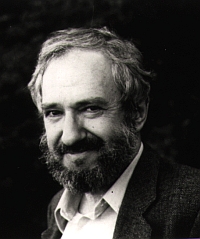
Professor Seymour Papert
School-style learning (traditional)
Later in primary school the way of learning is put upside down. Prior to school mistakes were valuable results of experiments to be learned from. The more experimenting a kid did the more results and with it the more mistakes she got and the faster she could learn and make the lessons stick.
Now in school making mistakes is bad and is punished. Therefore experimenting is no successful learning method anymore. Moreover the self-motivated, active exploration using all available senses is replaced by passive, mainly verbal "being taught" without any choice. No wonder that the kids are not very interested and the lessons do not stick so well anymore.
Another radical change of the early school years is the strong concentration on literacy and arithmetics. This made some sense in the past because only literacy allowed further exploration of mankind's knowledge collection called literature. But nowadays this verbal literature is increasingly replaced by electronic multi-media content directly available in the internet. Today the importance of literacy is still high but decreasing. It is not an absolute precondition anymore for exploration at primary school age. The new multimedia via computers would allow those kids to concentrate on exploration and learn reading and writing naturally on the side because they would experience its usefulness.
Hence they could acquire literacy much more easily with self-motivation at their own pace and make it stick by linking it with positive experiences. In fact the goal of literacy should be replaced by the more general term "technological fluency" i.e. to easily find your way through humankind's knowledge base using all sorts of techniques including literacy. Instead the kids have still today to squeeze through this bottle neck of acquiring literacy prior to understanding its usefulness by passive, unexplorative ways of learning and increasingly afraid of experimenting and making mistakes.
After mastering literacy it would be time to go on to discover humankind's sources of knowledge. But by now many kids' drive to explore and experiment is crippled and the schools sure don't revive it because making mistakes remains bad and therefore experimenting is not advisable even later on in their jobs.
A high percentage of the kids never go back to knowledge-exploring. Many drop-outs and "learning-disabilities" are caused by this unnatural way of learning in our schools. From now on too much learning is done by memorizing instead of understanding. (Teaching to the test). So the lessons can not be applied in different situations. And the general problem solving capability remains low.
What does Papert propose to solve this problem?
Of course he proposes to continue with the home-style-learning. He explains the principles beneath this kind of learning. And he gives many concrete ideas for activities that implement those principles using computers at home. For the application in school he only tells how not to do it.
E.g. learning to type or the usage of office programs in computer labs in the form of a separated topic "computer education" leaving all other topics untouched. But given the principles and the concrete examples of home-style-learning it is not too difficult for the reader to think of some concrete computer activities applying home-style-learning also in school.
What are those principles?
- MOTIVATION: Kids need to discover by themselves (not be simply told) the usefulness of a learning goal. Being highly motivated to learn about a new thing almost any learning method and content type will do.
- HARD FUN: If the motivation is high hard tasks are more fun than easy ones.
- POWERFUL IDEAS: Let kids discover the meaning of key ideas in human knowledge like the purpose of grammar in language or the meaning of the number zero in math.
- TO EXPLORE: Let kids autonomously immerse into new worlds in search for answers to (self-posed) questions or pursuing a self chosen task. Virtual microworlds offer a limited virtual world that can be thoroughly explored and completely understood.
They are suited for learning to use knowledge that require deep mastery. E.g. Nobody doubts that a English baby growing up in a Chinese environment easily learns the Chinese language. Why not create a math environment (Mathland) where a kid can learn math in the same natural way? Virtual hyperworlds offer a large world of casual, loosely connected knowledge (internet or subsets of it)
- TO CREATE: Make concrete or fantasy things using new elements and applying new rules to be learned. The traditional building blocks can be leveraged by virtual building elements of different kinds and behaviors.
- LEARNING STYLES: Be prepared to adapt to different learning styles
- TALENTS: Recognize and adapt to individual talents
- OWNERSHIP: Let the kids create artifacts that can be showed off and shared, give them the credit for having found out or created something.
- TECHNOLOGICAL FLUENCY: Make the kids discover and use new technologies for exploration and creation.
- TRANSPARENCY: Make complex systems transparent in order to understand it or at least its concepts.
- ACTIVITIES: The kids are active not passive. They are in charge, make choices. They are producers not consumers.
Create a virtual multimedia greeting card as a gift for a relative. Install and test communication channels with remote members of the extended family.When you plan to buy a car or a digicam let the kid gather market information. If somebody has a pet let the kids make a multimedia presentation with related information. Let the computer tell a story using different effects. There are many more examples for home usage.
Concrete examples of activities in school
Examples for school exploration projects could be like "What is the anatomy of a slug?" "How does an autopilot know where to go?" Examples for creating: "Make a (LOGO) computer program that automatically generates simple poems." As a long term group project: "Create a learning software about street making" or any other topic of choice. "Program a simple (LOGO) video game like pacman. "Create a web page on turtles"
What problems does the book not deal with?
Schools need to select a number of "powerful ideas" that the kids should find out about. Which ones? Then they should decide which sets of skills and knowledge should be chosen to be either mastered deeply or to be covered casually. This could become the new form of "open" curriculum maybe in form of a priority list like very few "must-haves" and others to choose from.
Then a number of activities to choose from have to be invented that cover the selected areas in the desired deepness adapted to different learning styles. This could become a new kind of "open" lesson plan. There should be much more freedom of choice for teachers and children to adapt to local and current situations.
However, it should be ensured that this sequence of activities can achieve a similar or better learning progress over the available time in school than todays traditional schools. It must be ensured that individual needs of talented and weak kids and different kinds of learning styles can be taken into account so that all kids can optimally advance their individual talents. Some kind of assessment of the learning progress of each child should be established in order to recognize learning problems early.
What are the side effects?
The separation of topics in school might not be necessary anymore. Because a single exploration or creation project could easily cover many traditional topics at the same time. E.g. if kids create a website about Lake Michigan they can learn about geography, biology, history, language, art, math, you name it. The best activities are probably going to be interdisciplinary.
That requires the presently specialized teachers to work together more closely. This might also mean that multiple teachers need to be present during such activities. The traditional strict curricula and lesson plans do not fit anymore. The assessment of the learning progress has to be reinvented completely. Maybe it will contain more elaboration about each kid's learning styles, set of talents, technical and social skills not just performance.
Teachers loose their master position and become servants of the kids' learning process. But in return they are rewarded with much more individual influence in the kids' learning than just repetitive teaching of content.
It might easily be that kids create themselves learning software for other kids in their projects that might be superior to those developed by adults because they think and perceive the world with minds of kids. Beside giving kids knowledge and skills contemporary schools also standardize educational levels and hand out certificates of achievement for them.
Is this standardization and the certification still required in the future? By the increasing technological fluency there might be much stronger interaction of kids from different countries and cultures creating more mutual understanding and respect. That might have a positive influence on the solution to the problems of their generation like environment or conflicts about scarce resources etc.
As you have recognized by now the principles given in Papert's book are really inspiring. But they require openness to profound change mainly from the education sector but also from parents and the public. Although there is much room for change in wrong ways there will also be high tolerance for errors provided high motivation of the kids can be achieved in the first place. The promise seems realistic and is certainly worth trying hard.
As a reward for having read my long post you have earned yourself this video of a brilliant speech by Ken Robinson that is as inspiring as hilarious
.


Sounds very interesting, Roland.
The problems with all these theories is that they are based on "circular reasoning": if we do the right thing, things will be right.
Of course, if we stimulate kids creativity, kids will be more creative. If we make the learning more exciting, kids will be more excited about learning. If we give kids the opportunity to explore, kids will explore. If we provide kids with activities, kids will become more active.
Duh?
There's nothing new there. The problem is that those are GOALS, and not METHODOLOGIES.
Those "principles" tell you what we should strive for, not how we should actually do.
Tht's why you couldn't find an implementation plan ("How to base a full school education on these new principles is unfortunately neither detailed in this book nor in Papert's subsequent articles that I read so far.").
That's why nobody, including Papert, has put those theories in practice with any success. They sound good, but in the end, they are just "feel good" nonsense, generic advice without any scientific foundation.
The reality inside the classroom is MUCH different and far more complex that a little book will ever convey.
Constructivism is a bit like Socialism. We can't have a socialist collective, but we can universal healthcare, social security, welfare, etc. We can't have a Constructivist utopia, but we can have visual-spatial learning, tangible class excercises, etc.
In a real classroom the teachers use the technology rather than idealogy. LOGO is dialect of LISP programming, and Squeak is an improved version of Smalltalk programming.
In real life the students are older than in the pictures (4th to 8th grade), and the teachers were molding the technology to their purposes.
They should just focus on making low-cost computers to close the digital divide in society and allow wider use of the internet. Low-cost laptops are a good idea, but they should not be used to market an idealogy or propaganda.
I think the real problem is MIT. As I have said this is not a new idea, Alan Kay at Xerox PARC did this in the 1970's with a project called Dynabook, but the Dynabook outstripped the technolgy of the day by several decades. He decided to just focus on visual-spatial learning and programming software.
The top tech guru at MIT, Marvin Minsky, has been promising to make an IBM mainframe think and talk like a person for over 50 years and has yet to deliver. Noam Chomsky, another MIT guru, has been promising the underlying principles of human langauge and thought for over 50 years. MIT has promised a multi-user "Time-Share System" that can beat the personal computer paradigm (Project MAC & Project Athena)for over 40 years: this is how MIT does things. MIT makes vaporware. They should give the project to a more results oriented place. The guy that really made LISP and LOGO, John McCarthy, is at Stanford.
Assuming the above outline of Papert's ideas is reasonably
accurate, I must say that as a person who has closely monitored
the early learning of at least one mini human, it's far from
stressless, joy-laden, self-motivated. It's work, and its nature
varies by the child's age. The Papert summary seems like a
pastoral caricature intended to inspire someone with no direct
experience.
I wouldn't say that nobody have put those ideas into practice. Schools like Sudbury Valley (http://sudval.org) have decades of experience showing that if you just create a stimulating environment, children can learn on their own, without the intervention of teachers.
They seem to have a quite extensive literature documenting their results and success rate.
Dick Einstein,
like many of the bloggers here at OLPCNews.com I became interested in OLPC because of its interesting hardware development. Being no educator instructionism and constructionism were completely new to me. I got interested in constructionism because it is a central issue of the OLPC project. It is difficult to find clear information (for laymen) about it.
I agree that these principles are not clear recipes which you can just follow. These principles are more like guidelines or threads that should be woven into the implementations. Yes, the implementations still need to be worked out. Some are already being created in form of programs for the XO. Then also scientific tests must be carried out to prove the effectiveness of those new implementations which is in itself quite a challenge. But the status of the implementation is still very far from having complete collections of activities to cover a full education. And AFAIK there are no scientific test results yet.
But I do not agree that these principles are nonsense only because they are not simple recipes that we all like so much. Just do this and then that and the revolutionary results are at hand. Unfortunately in real life there are no quick fix solutions for hard problems. Their solution tend to involve hard thinking and then even harder work and also a process of trying and improving.
These principles address the core issues of education and give criteria that should be met by implementations if they are to be successful. They show you the direction but you have to walk on your own.
It is not "feel-good-nonsense" because feeling good is not the primary goal but a side result by learning in a more effective way. Effective medicine does not necessarily have to be bitter.
Although the implementations of those principles need testing, the principles themselves already make sense to me by being compatible with my own experiences as pupil and student.
I just recognized that the link to your hard earned video at the end of my post got lost.
Maybe Wayan can still add it to the post.
In the meantime use this link:
http://www.youtube.com/watch?v=iG9CE55wbtY&mode=related&search=
Roland wrote:
"These principles address the core issues of education and give criteria that should be met by implementations if they are to be successful. They show you the direction but you have to walk on your own. "
Roland,
educators have known about those issues for centuries. Promting learning, creativity, fun, discipline, motivation, etc., is part of every school's philosophy. It is being practiced today. Papert is not advocating something new or extraordinary.
If he could actually show two things, his position would acquire instant validation:
1. Provide a clear implementation methodology
2. Show measurable results that are consistently and significantly above those of more traditional methods of education.
That's not much to ask, is it?
So far, we have some "feel good" ideas thrown around. Anyone can do that. Educating children in a real classroom is a VERY different ballgame. A teacher is not only an instructor. A teacher wears many hats during the day: social worker, psychologist, mediator, health care worker, disciplinarian, etc.
Remember: not every kid is equally bright, not ever kid is emotionally well-balanced, not every kid shows the same motivation, etc., etc.
Kid's school performance can be drastically affected by emotional, psychological, financial, physical issues and more. A teacher is always attent to the little signals of trouble or progress: is this kid sexually abused? is that kid well fed? is this kid being affected by some family situation? is this kid dyslexic? is that midl autism? should this kid be tested for learning disabilities? Why is this kid so intelligent and yet so unmotivated? There are literally hundreds of issues that go well beyond teaching basic math.
That's why "feel good" goals and the reality of ACTUAL TEACHING are so different.
Regular schools, for better or worse, do their walk every day - has Papert ever even tried to crawl from behind his nebulous ideas? What were the results?
Roland,
The Connected Family was written for an audience of parents--as you noted. Papert's previous book, The Children's Machine (the cover art is in the article) was written for teachers about school. An even earlier book, Mindstorms (again, the cover art is there) was written for academics.
If you are interested in Papert's ideas about school, you should definately read The Children's Machine.
Sorry Wayan, the link is ok. I was using a Linux box without flash installed. Then I saw nothing about the video not even the link.
Dick Einstein,
I agree with most you say in your last comment.
Maybe I am naive on this but your comment seems helpless to me. Basically you're saying that if Papert or anybody else was insuccessful so far implementing those principles it cannot be done or ist not worth trying. If everybody had this attitude we would still live in dens.
1)Wouldn't the explorative learning liberate teachers from repetitive lecturing and give them more time for all those more valuable tasks you listed?
2) Do you think being passively taught or being punished for mistakes until you never dare to experiment anymore are good concepts? Don't you want to change that? Don't you have some ideas how this could be done?
3)Yes, Papert has not given us clear implementation instructions. Has anybody else come up with some? Although not easy it cannot be impossible to work it out. Somebody just has to start with it and others will improve on that. Negroponte is at least giving it a try. Although his atempt seems less than perfect I have seen nothing better yet.
Sylvia Martinez,
thanks for your hints on Papert's books. Have you read those books? Could you post a short summary?
Quote:
"Another radical change of the early school years is the strong concentration on literacy and arithmetics. This made some sense in the past because only literacy allowed further exploration of mankind's knowledge collection called literature. But nowadays this verbal literature is increasingly replaced by electronic multi-media content directly available in the internet. Today the importance of literacy is still high but decreasing. It is not an absolute precondition anymore for exploration at primary school age. The new multimedia via computers would allow those kids to concentrate on exploration and learn reading and writing naturally on the side because they would experience its usefulness."
I'd be very careful about all the multimedia hype. We live in a saturated multimedia world, with massive amount of information available, but with minimum guide on relevance. A kid may find its way through or get lost on the way. Some sort of literacy background, which means in fact some guided fundamentals, may help forming in the kid some way of discerning and choosing what makes the available material worthed. Reading and studying classic literature although it may sound boring when compared with all the "electronic multi-media content", but at the end tremendously useful. So literacy for me is of primary importance, mostly these days. I'd be happy if a kid, as a result of such literacy training, could see why an entry in a blog is not the same as a properly documented entry in an encyclopedia.
Einstein,
"Of course, if we stimulate kids creativity, kids will be more creative. If we make the learning more exciting, kids will be more excited about learning. If we give kids the opportunity to explore, kids will explore. If we provide kids with activities, kids will become more active.
Duh?
There's nothing new there. The problem is that those are GOALS, and not METHODOLOGIES."
I believe your logic is flowed (or is it just your terminology) and you need to rethink what you've just written in the quote above.
To "stimulate kids creativity", to "make the learning more exciting" and to "give kids the opportunity to explore" _are_ principal methods of a particular educational METHODOLOGY (eg. [1]Constructivism or [2]Montessori method) and are sadly either not used at all or used in a very limited way in the traditional instruction-based education.
The results of using this METHODS, as you yourself stated, is an environment where "kids will be more creative" ,"kids will be more excited about learning" and "kids will become more active" and, ultimately, kids will learn faster and/or more the desired skills, ie the GOALS of the process we had in mind.
Of course, a 'teacher' who will successfully use these methods will not only poses certain characteristics (eg. humor and imagination) but also be able to teach in environment where these methods are encouraged and appropriate tools provided. Which brings us back to XO used as a very versatile tool for such an environment providing (e)books, 'encyclopedias' and 'dictionaries', writing and painting pad, learning music, remote communication and collaboration with others and [3]exploration of ideas...
[1] Constructivism
( http://en.wikipedia.org/wiki/Constructivism_(learning_theory) )
[2] Montessori method
( http://en.wikipedia.org/wiki/Montessori )
[3] Selection of Etoys created by kids and adults for your exploration, learning and play.
( http://www.squeakland.org/kids/sqfest_2004.htm )
Nick,
we are talking about primary schoolers here. You don't expect them to read the classic greek literature, do you?
At that age literacy is THE primary topic in traditional schools. And it is taught without letting the kids find out about its usefulness first. So from the kid's perspective it is taught as a topic for its own sake; not as tool for a purpose that can be exciting.
Roland, please, see my ansers below:
"Basically you're saying that if Papert or anybody else was insuccessful so far implementing those principles it cannot be done or ist not worth trying."
That's not what I said. What I said is that:
1. Educators have known about those goals for many years.
2. Reaching those goals in the classroom is a very complex process that requires a lot of work and knowledge. Teachers are doing the best they can under REAL conditions (remember, the world is full of normal people who went through traditional schooling environments). Papert or anyone else who claims that what has been traditionally done is utter failure requires that they show us a better manner of doing it - but they just talk the theory; nobody has ever shown better results than what is being achieved by traditional methods.
"If everybody had this attitude we would still live in dens."
See my previous answer. I'm only asking for proof that these alternative methods actually present an improvement over traditional methods. Is that being "retro"?
"1)Wouldn't the explorative learning liberate teachers from repetitive lecturing and give them more time for all those more valuable tasks you listed?"
Sounds nice, but how do you actually implement it?
"2) Do you think being passively taught or being punished for mistakes until you never dare to experiment anymore are good concepts?"
There is no evidence that the above is true. Kids just work in school.
"Don't you want to change that? Don't you have some ideas how this could be done?"
Change what? The lies fostered upon us about kids being "punished for mistakes until you never dare to experiment anymore "?
That's a transparent lie, Roland. Don't you see it?
"3)Yes, Papert has not given us clear implementation instructions. Has anybody else come up with some?"
That's the problem with Papert's theories.
"Although not easy it cannot be impossible to work it out. Somebody just has to start with it and others will improve on that. Negroponte is at least giving it a try. Although his atempt seems less than perfect I have seen nothing better yet."
That's fine. Give it a try. Just don't expect somebody to foot the humongous bill, in case you are wrong.
Roland,
When would you expect a kid to learn grammar or to write correctly? Should we wait until the kid is a teenager or a college student? Primary school is the best place to start. The problem is not literacy itself, but the way it is thought. The same can be said for arithmetics and sciences.
If everything is handled in a pleasant and unstressed, and active environment you can introduce pretty hard concepts, properly presented for your age target, the kids needs involvement, but also guidance.
The fact that the topic is learnt without context is where the problem is. The solution you propose ("let's the kid find his way, the rest would come"), is utterly optimistic.
I'd rather suggest a mid-way, pragmatic solution, where a topic is presented by the teacher within a well defined context, which the kid must be comfortable with. It's the context that makes it interesting!
P.S. Classic literature is not necessarily Plato or Socrates. There is a widely available classic literature for children which did a pretty good job so far in providing the necessary level of literacy.
Dick Einstein,
since you seem to even question the basic statements about traditional school you should give us your view on it:
a) Are kids facing artificially *) introduced disadvantages for making mistakes in school or not? Like getting no brownie points, lower grades, not being promoted?
*)real disadvantages for making mistakes might be misunderstanding a written note of a friend due to a language mistake. Or paying too much at the market due to a calculation mistake.
b)if a) is a yes then does that negatively affect the kid's readiness for experimenting?
c) Do you need a scientific study with representative sample size and reference sample to answer b)?
Nick,
I also think that guidance of a teacher is necessary. The kids cannot be totally left on their own. But this guidance should be given if kids loose themselves or get stuck in their explorative activities. The amount of direct lecturing should become the exception and guided explorative learning the rule.
a) Are kids facing artificially introduced disadvantages for making mistakes in school or not? Like getting no brownie points, lower grades, not being promoted?
No, they are not. What you call "artificially introduced disadvantages" is what the entire world call "grading student performance". Some students will naturally get higher scores than others.
b)if a) is a yes then does that negatively affect the kid's readiness for experimenting?
There is no proven relationship WHATSOEVER between a kid's desire to experiment and his academic scores. Don't let the nonsense cloud your judgement. Where do you get the notion that there is a connection?
c) Do you need a scientific study with representative sample size and reference sample to answer b)?
Use your intelligence, Roland. You are losing your objectivity here. The problem with your analysis is that you have accepted a COMPLETELY UNVERIFIED PREMISE: that traditional education stunts creative and intellectual growth. Have you seen any proof that such premise is valid?
Have you ever seen the wonderfully creative humans that constructivism has produced?
Where is that group of superior humans?
It's all bullshit, my friend.
Dick Einstein.
Dick Einstein,
You wrote:
"a) Are kids facing artificially introduced disadvantages for making mistakes in school or not? Like getting no brownie points, lower grades, not being promoted?
No, they are not. What you call "artificially introduced disadvantages" is what the entire world call "grading student performance". Some students will naturally get higher scores than others."
You denied that making mistakes in school does lead to getting no brownie points, getting lower grades, not being promoted. And in the same answer you admit that it is natural that some kids get lower grades. Your answer is self-contradicting!
The point I want to make is not that giving a kid lower grades is "unsocial" or hurting the kid's feelings or such softy-talk.
My point is that the traditional student grading system creates a completely wrong kind of learning motivation. In this system learning is a defense to avoid mistakes. This is a negative, extrinsic motivation i.e. trying to prevent something negative from happening to you in which experimenting is not a successful strategy but memorizing is. Successful students have not achieved something positive but avoided something negative. Having been successful in avoiding mistakes does not wet the appetite to avoid more mistakes.
Instead learning should be driven by a positive, intrinsic motivation to achieve a learning goal based on real interest in it. In this process experimenting and making mistakes are valuable steps to not only reach the learning goal but also to understand it as compared to just memorizing it. Having successfully achieved and understood a learning goal is so satisfying that it wets the appetite to achieve more and harder goals.
Of course in traditional school both types of learning happen. But the negatively motivated learning is predominant. Positively motivated learning should be made the rule not the exception.
Of course, students have to be graded as a feedback. But this grading should be based on what goals they have achieved and not how well they avoided mistakes. The work of a student should be marked based on its achievement not on its mistakes.
Roland,
there is no contradiction in my post, if you read carefully.
You're basing all your reasoning on a simple, unfounded premise: that traditional schooling "punishes mistakes" and therefore, kids become so scared of making mistakes that they stop being "creative" and they stop "experimenting".
Your "reasons":
1. "Kids get no brownie points for making mistakes" - NOT TRUE.
I think you don't know what the expression means, especially within a classroom context. Check a brief explanation here:
http://en.wikipedia.org/wiki/Brownie_points
Brownie points have NOTHING to do with kids making or not making mistakes.
2. "Kid get lower grades for making mistakes" - FALSE.
Grades (low or high) are just a numeric representation of a kid's performance within the classroom. Low grades indicate a kid is underperforming (for a great number of reasons) - NOTHING TO DO WITH MISTAKES.
3. "Kids are not promoted when they make mistakes" - FALSE.
Kids are not promoted when they don't reach the minimum performance requirements for promotion. No connection whatsoever with making or not making mistakes.
Once again, Roland, don't fall for the hype, because it is a transparent little lie - a silly play on words. If you have any doubt, go and try to find the superhumans that constructivism has produced. Good luck!
Dick Einstein
Einstein,
"Kids are not promoted when they don't reach the minimum performance requirements for promotion. No connection whatsoever with making or not making mistakes."
Sorry, but this is (as many other of your statements) nonsense. "Performance" is very often directly measured as the result of the least mistakes made. A multiple choice test is an obvious example.
Sorry, Delphi, but nobody has ever seen a kid not being promoted because he "made mistakes" in a multiple choice test. It takes far more than that to deny promotion to a kid.
Mistakes are natural and they are properly dealt with in a normal classroom setting. Everybody knows that.
Dick Einstein
Just a tidbit of interesting information I stumbled across while watching the latest episode of Diggnation (http://revision3.com/diggnation):
Sergey Brin and Larry Page (Google), Kevin Rose (Digg) and a couple of other IT entrepreneurs all went to Montessori schools when they were young.
Dick Einstein,
I don't know in which world you live. But in the traditional school I attended to avoiding mistakes played a very important role.
ChristophD wrote:
"Sergey Brin and Larry Page (Google), Kevin Rose (Digg) and a couple of other IT entrepreneurs all went to Montessori schools when they were young."
Einstein, Descartes, Picasso, Neruda, Hawkins, Jesus, Socrates, Tagore, Gibran, Curie and Paris Hilton did not.
:-)
Nick,
"When would you expect a kid to learn grammar or to write correctly? Should we wait until the kid is a teenager or a college student?"
Of course, I agree with you that the best time for learning literacy is primary school.
But there are a few important points about that:
a)The kids should be motivated to learn reading and writing because they know its usefulness from first hand experience. E.g. because they experienced that reading helps to do things they like and value.
b)Laptops and multimedia content allows kids to autonomously explore new areas of knowledge with no or little literacy skills. This is new in mankind. This could be used to initially make kids autonomously learn e.g. geography or biology and learn literacy while doing that on the side. Then learning to read has an immediate purpose for the kids. And if some kids take a little longer to master literacy there is not so much pressure necessary anymore because the multimedia contents used in the beginning allows them to continue follow their geography or biology.
During my school time, in the kid's perspective learning to read was for its own sake or for the teacher's sake. And it was a necessary precondition to go on learning other things. So a lot of pressure was usually used if kids had problems with reading.
Dick,
Since you mention him, have you read Einstein's views on traditional education?
Its seems that Dick is taking a beating over his stance that Papert has not 'Provided a clear implementation methodology'.
You dont need to be an Einstein to realise its like asking 'How Do I Teach?'. The good teachers are those that go outside the box and bring their own creativity into the classrom.
Its no accident that teachers that receive awards are the creative minds that bring constructivism to the students. One such teacher started a television station at the school as part of 'Media Studies'. The students learn by doing. Sounds like something Papert might do.
You also don't have to be an Einstein to realize he hasn't gotten much in the way of answers to the perfectly reasonable question, "how are you going to do it?"
It shouldn't be that difficult a question to answer. Create a mock up or small but illustrative segment of the way you plan to do it. Do something, anything to show how the XO will facilitate learning via constructivism.
Does it seem at all unreasonable for the education ministers of the interested nations to want some demonstration of efficacy before committing large, *extra*, funding to public education? And it's not as if anticipating a requirement like that takes any particular insightfulness. The questions will be asked and that won't be the time to come up with answers.
So let's see a sample. The educational software ought to be in a fairly advanced state of development with hardware scheduled for delivery in just a few months. I'd download it in a heartbeat to see how constructivism ought to be done.
allen (et. al), The XO laptop is a tool much like any other tool used in a classroom. You could call it a typewriter, a library, a recording studio, a photograpy lesson...should I go on?
Of course I should, for the benefit of those too stupid to understand. Let me enlighten you.
The student is asked to write a play and act in it with two school friends. They use the XO's to colaborate in writing the play, maybe each one writing their own words in a shared, networked document. They can all open it and see what each other has typed. They set up an XO to record their 2 minute play, with sound. They have it stored on the school server and all the students can take home the play video to watch.
The students decide to look at how drought is affecting their country. They use the information collected by their Government in the on-line database detailing arable land for the last ten years. They go to Google Earth and access images for their country. They use the XO connected to an anemometer to get wind speed and direction and temperature. They start a spreadsheet and log weather information observed from their home every morning. They publish their findings in a web site created on their XO laptops.
Students are doing a study of flora and fauna. They go out into the bushland in pairs and use the XO to photograph plants, take samples of leaves, write a note about the plant and store it in their journal. At shool the children collate their collections and write a book about the plants and possibly insects, fungus etc.
Maybe they also study water quality in the area. They take samples of water. Document acidity measured with litmus paper.
Music is a big part of socialisation. The students decide to compose some music using Tam Tam, the music program that comes in the XO. After two weeks the children have colaborated with each other and play their song from ten different XO laptops around the room. One sounds like a bass drum, another like a violin, a third like an oboe. The children have written a song, lyrics composed on the XO laptop, colaborated together.
These are a few examples of how the laptops might change the lives of school students that, last year, had a lead pencil, a text book and, hopefully, an eraser.
Robert Arrowsmith is correct in saying that laptops MIGHT change the livbes of school children, but consider - for how many kids will these examples occur spontaneously and without adult involvement and motivation?
I think that the answer is: not many. There would always be examples here and there, but the OLPC's approach is based upon a sweeping, universal concept - airdrop the laptops to every kid in the country and you no longer need teachers - the kids will do it all by themselves.
Montessori methods call for a carefully controlled learning environment and for careful supervision by teachers. I would love to see it implemented using XO laptops along with the other items that the computer would not replace (e.g., tactile items).
Montessori teaching has a long and well-documented history, quite unlike "constructionist" learning (whoops, I almost called it "teaching"). Montessori teachers have to be well trained and qualified.
Given universal availability of laptops like XO it would become possible to make Montessori education available universally, but there would be a very great deal more work necessary before this possibility could be realized.
Childhood education is not simply a matter of having the right machine. The machines can only serve as tools which must be prepared by adults for the kids to use. This fact cannot be altered by being ignored.
I refer readers to my blog entry "Alan Kay Comes Through" http://fonly.typepad.com/fonlyblog/2005/11/alan_kay_comes_.html
for Kay's view of the hierarchy of tasks. It shows better than most other commentaries why OLPC has got it backwards.
Lee, I agree that learning using XO laptops should be managed by teachers but in an open and unstructured way. Guidance is important but the whole thrust of my arguement is the student should drive their own road to discovery.
University students learn to search for source information and so write a thesis. This is the way children also learn, by seeking out answers to questions. The source of the questions are normally the teachers but why cant the student ask their own questions.
The examples I've outlined previously are situations where children learn by doing, not being told. These methods let children learn by asking their own questions and searching for answers.
Quote:
"University students learn to search for source information and so write a thesis."
University students also benefit from the presence of a mentor or advisor in find their way. They are not left alone in the process. They enjoy the creative learning process, but the presence of an advisor actually helps the students develop the sense of what type of question he should ask himself.
"They enjoy the creative learning process, but the presence of an advisor actually helps the students develop the sense of what type of question he should ask himself."
All of this is true. But it is also true that the teacher is allowed to allot only a dozen or so hours (often less) for supervise each 3+ month thesis. That is, less than six working days per student per year! This includes reading and correcting the thesis. The student is quite a lot on her own. This organization is helped A LOT by efficient communication and computer technology. Think of putting comments on a text document and email, versus meeting in person and using a hand-written paper only (typing out the final version only).
I reality, most supervisors spend more time. But not THAT much more.
Winter
Robert Arrowsmith wrote:
"Its seems that Dick is taking a beating over his stance that Papert has not 'Provided a clear implementation methodology'."
That's your opinion, based on...nothing, as Allen pointed out.
Do you have a simple, clear answer to the obvious question: what's the implementation plan?
Look at your "implementation plan" example:
[quote]
"The students decide to look at how drought is affecting their country. They use the information collected by their Government in the on-line database detailing arable land for the last ten years. They go to Google Earth and access images for their country. They use the XO connected to an anemometer to get wind speed and direction and temperature. They start a spreadsheet and log weather information observed from their home every morning. They publish their findings in a web site created on their XO laptops."
[/quote]
That's chid's fantasy, at best. Not different than this other "use" (based on your "brilliant" sample above):
"The students decide to look at how poverty is affecting their country. They use the information collected by their Government in the on-line database detailing economic conditions for the last sixty years. They go to Google and access financial data for their country. They use the XO connected to the American Stock Exchange and begin trading on a small amount of stock. They start a spreadsheet and log transaction information from their home every morning. They save their profits and publish their trading strategy in a web site created on their XO laptops. Soon, all kids in their poor village are millionaires"
Not what anyone would call an "implementation plan", to put it in a polite way.
Dick,
"That's chid's fantasy, at best. Not different than this other "use" (based on your "brilliant" sample above)"
I think that's exactly what you are lacking: imagination. It is sad that every child seems to have more. You seem to be a severe victim of the old schoolsystem yourself that constructionism is invented to prevent in the future.
"Not what anyone would call an "implementation plan", to put it in a polite way."
Only because those examples do not fit your image and you cannot imagine how these two proposed themes can help education and could indeed be part of an implementation plan and be examples for more similar activities in that implementation plan is no reason that they are not valid.
And please, do not write on behalf of "anyone" because that could include also me. And I certainly do not share your views. Moreover, I doubt very much that the majority of "anyone" shares it.
Instead of always calling all the comments wrong but not telling what you think would be right why don't you explain us what learning method (instructionism, constructionism or else) you would prefer for kids and what your idea of an implementation plan for that would be.
Robert, I find your examples intriguing, not necessarily by the right reasons. Besides that almost all of them can be done without a computer, there's one in particular that I find at least baffling:
"The students decide to look at how drought is affecting their country. They use the information collected by their Government in the on-line database detailing arable land for the last ten years. They go to Google Earth and access images for their country. They use the XO connected to an anemometer to get wind speed and direction and temperature. They start a spreadsheet and log weather information observed from their home every morning. They publish their findings in a web site created on their XO laptops."
First of all: why do you assume that there's such a thing as a "on-line database detailing arable land"? Why do you assume that such a database is conceptually and methodologically useful for the kids? Why do you assume that any of the data will make any sense at all, without at least some fundamentals on how, why and when to collect it?
Most probably, your answer would be that kids interested in this line of inquiry will be able to surmount all the hurdles through their own initiative. OK. So we're talking about less-than-average kids.
I cannot imagine that there will be such a large number of kids under 14 with the abilities, the intellectual curiosity and the time to do so many things. We could probably discuss about the innate ability kids have to do great feats of learning when the environment is right, something that is so far wishfulthinking instead of at least a sound hypothesis.
At least from my point of view, this kind of self-learning is the best argument for NOT providing all kids with computers. There are bright children, with a lot of potential, that are underserved by education as it currently works. They'll do wonders in such an environment, and with such tools. But does it make sense to bring tools, fit for a minority, to all the kids in one country? Wouldn't it be better for all those involved to provide this kind of opportunities for those that may be able to take the better advantage from them?
"I think that's exactly what you are lacking: imagination. It is sad that every child seems to have more. You seem to be a severe victim of the old schoolsystem yourself that constructionism is invented to prevent in the future."
I'm not lacking in "imagination", Roland. Unlike you, I use common sense. You just read the wrong book, and are sold on ideas you can't begin to comprehend.
Use some intelligence to read Arrowsmith's example and you will see how it is pure fantasy. Look at how "possible" or contrived his example is - let me show you.
"They use the information collected by their Government in the on-line database detailing arable land for the last ten years."
Can you post a link to ANY of these "on-line databases"?
"They use the XO connected to an anemometer to get wind speed and direction and temperature."
Is there any evidence that these two PARTICULAR (read carefully to avoid nonsense)devices can be connected and made to work together?
"They start a spreadsheet and log weather information observed from their home every morning. "
Aren't the kids supposed to be at school on mornings?
"They publish their findings in a web site created on their XO laptops."
The kids (ages 6-14) are now web developers, designers and content publishers!
C'mon, Roland! How obtuse can you be?
Don't you see the whole thing amounts to a simple: "if you give these laptops to kids, they will do wonderful things with them" - a promise and nothing more than that.
What is needed is not "imagination" - any person can come up with thousands of contrived, unrealistic scenarios like the one presented by Arrowsmith. What is really needed is intelligence to objectively examine the claims and ask for proof that there is, indeed, a SERIOUS, REALISTIC implementation plan that goes beyond the empty promises.
Dick,
if you are so intelligent, serious and realistic then why don't you tell us what your preferred serious learning method is and how to realistically implement it?
Roland wrote:
"Dick,
if you are so intelligent, serious and realistic then why don't you tell us what your preferred serious learning method is and how to realistically implement it?"
Very easy answer, Roland: the current methodology, as implemented throughout the world - with teachers in charge of teaching and students in charge of learning - is the best method. It's tried and true. Implemented and tested.
Is it perfect? No, it is not.
Can it be improved? Yes, it can.
Should we try to improve it? Yes, we should.
Is constructivism the way to improve it? Nobody knows, because it has not been done in a DOCUMENTED manner (as in showing "before" and "after" results).
The good news, Roland, is that you don't need to be an Einstein to understand these ideas; they are so simple even a real Dick can get them ;-)
Dick Einstein
Shouldn't all this be less personal, avoiding name-calling and the like? While I can find the ideas interesting, the actual discussion is getting unnecessarily ugly.
Dick,
I agree that the current system is proven but not perfect.
I would like to learn from you how to improve it.
And before you can prove constructionism in a comparative test you need to have an idea how to implement it because you can only prove implementations not general theories.
So I would also like to learn from you what implementation of constructionism has the best chances to be proven superior to the current instructionism.
And don't worry I will not jump on irrelevant details to prove you wrong, as you often do e.g. whether an anemometer has a thermometer or not... I am ready to discuss your ideas on conceptual level.
Eduardo,
"Besides that almost all of them can be done without a computer,...."
If a learning method could be found that is superior to the current school system, that can be applied in the 3rd world and in which computers are not needed or play only a peripheral role, we could all be very happy, couldn't we?
Roland wrote:
"So I would also like to learn from you what implementation of constructionism has the best chances to be proven superior to the current instructionism."
I have no idea, Roland.
That question is best sent to those who make the claim, don't you think?
I don't even know - and neither do you - that "constructionism can be proven superior to the current instructionism". That's for Papert and Co. to demonstrate with documented "before" and "after" trials.
So far, NOBODY has conducted a controlled, documented study where Papert theories on education have been:
1. Implemented AND
2. Once implemented, produced better results than conventional methods.
Now, don't get me wrong: I'm NOT against trying new approaches in education. I'm all for positive change and innovation (as in trying new things - YES, including constructionism).
However, I'm against poor countries spending billions of dollars to finance the testing of Papert's theories. If the laptops were given to kids on a free basis, I'm behind Negroponte 100%.But they are not free, unfortunately.
To close my post and in all fairness to Negroponte, I'll propose a revolutionary idea: why not offer the XO to rich countries first (USA, Germany, France, Israel, Canada, etc)?
There are several good reasons for doing so:
1. They have the money and can better afford the inherent financial risk
2. Their kids can also take advantage of the wonderful new learning possibilities that the XO brings to the table - the OLPC concept is a first in history - for rich and poor alike
3. The OLPC Project is not delayed anymore - orders will be placed on the spot
4. Rich countries have a very good technological infrastructure in place where the XO will shine
5. Rich countries have the resources to best evaluate the effectiveness of the XO in elementary schools and the extent to which they can improve a kid's school performance.
6. Poor countris will get a chance to make an informed purchasing decision based on a tested product, thus eliminating their financial risk.
What do you think?
I would love to see OLPC XO in American schools. Or European ones. In fact, I am surprised that a progressive country like Sweden or Norway isn't already on the participating countries list. Not only would they have the purchase money, they would also have more resources for implementation experimentation - refining the process to save poor countries the expense and hassle.
Wow, to my surprise I agree with you with with everything but point 3.
Rich countries could have afforded to implement constructionism with standard laptops also, if they really would have wanted to. But constructionism did not succeed yet in the 1st world. And I doubt that 1st world countries will place orders with OLPC on the spot. Now this could be blamed to the method or implementation being wrong or unproven although it could start on a small scale to be proven.
But there could also be other reasons for being not interested.
a) Inertia against and fear of change.
b) Lack of imagination. "If I got my education instructional style and I became so serious and intelligent then it has also to be the best for my kids"
c) Instructionism makes many kids submissive to authorities also later as adults. Those who do not become submissive and do not hide it are filtered out. Maybe the authorities fear a large number of independent thinkers that ask uncomfortable questions let alone come up with their own solutions.
d) The educators fear they might not qualify for the new challenges of supporting those learning methods.
So we cannot expect the ministries of education to turn themselves upside down. The movement must be coming from the public. The public should be made more aware of the shortcomings of our current system and the improvements, although yet to be proven, that alternative methods promise which might be worth to get active.
Therefore, we should discuss the educational methods of OLPC and others much more than its technological side.
"Instructionism makes many kids submissive to authorities also later as adults."
Can you substantiate this claim, or are you just parroting other people's claims?
"Those who do not become submissive and do not hide it are filtered out."
Where are you getting these ideas from? (own experience doesn't count - let's save time)
"Maybe the authorities fear a large number of independent thinkers that ask uncomfortable questions let alone come up with their own solutions."
Pure nonsense.
Are we going to believe that the "authorities" are keeping mankind "ignorant" for fear of "uncomfortable questions"?
Are people in Sweden, USA, France, Israel, Canada, Spain, Switzerland, Germany, Italy, etc., "dependent thinkers", unable to ask "uncomfortable questions" because they were "subjected" to traditional teaching methods?
I must admit that my "imagination" is not as rich as yours. Perhaps deep down I'm just afraid of looking at things in a different manner! :-)
Dick,
discussion style:
this is a blog discussion not a court of law. I express my opinion based on my experiences that I do not have to prove by literature references and statistical studies. Why should my own experience not count? Maybe you made different experiences. Then tell about them.
Of course you are free to call them wrong. But then I would appreciate it if you gave a reason why you think they are wrong apart from saying I could not prove it. You give no proof for your opinions either. But don't worry I don't require it.
To your point 3.):
What makes you think that western countries would order OLPC on the spot? Or why do you think they don't.
Roland wrote:
"this is a blog discussion not a court of law. I express my opinion based on my experiences that I do not have to prove by literature references and statistical studies."
Claims are only taken seriously when backed up by documented data.
"Why should my own experience not count? Maybe you made different experiences. Then tell about them."
Because your personal experiences (just like mine) are STATISTICALLY IRRELEVANT. Let me give you an example:
'People usually survive 20-story falls. I base my statement on the fact that my nephew fell 20 floors and survived with only a few fractured bones'
While it is TRUE that the nephew survived the 20-story fall, that DOESN'T MEAN that it applies to all people or all falls.
"Of course you are free to call them wrong. But then I would appreciate it if you gave a reason why you think they are wrong apart from saying I could not prove it."
They are just "unsubstantiated" claims (like "Instructionism makes many kids submissive to authorities also later as adults."). Your intentions are good, Roland - I have read every one of your previous posts in this blog and have great respect for you. However, on this issue of contructionism and its positive effect on people vs. traditional methods, you are making claims based on...what you read from the person making the claim. More is needed in order to support your ideas.
"You give no proof for your opinions either. But don't worry I don't require it."
I'm not making any claims. I have NEVER said that traditional methods are the best or only ones. I'm only pointing out the evidence: so far nobody has implemented a better way that we know of.
"To your point 3.):
What makes you think that western countries would order OLPC on the spot? Or why do you think they don't."
Of course they WILL NOT, Roland. For the exact same reasons poor countries won't: the claims made by Negroponte and his team are not verifyable and a bit hard to believe. There is no implementation plan, which essentially makes this a "laptop" project, not an "education project". And even then, nobody knows how good or bad the hardware will perform once deployed. In short, too many questions surround this project for anyone to risk billions of dollars on Negroponte's word alone.
Finally: I'm the first one to admit that I have NO IDEA as to how many of his promises Negroponte will deliver. It is very possible he will reach all his goals - it's also possible he won't do very well. I remain a simple spectator.
Dick,
"Claims are only taken seriously when backed up by documented data."
Unfortunately, often in life you have to take sides without objective facts at hand. Then you have to rely on subjective methods. One of them is to check the claims against your experiences. Another method, called "intersubjective", is to discuss the claims with others and see how it checks against their experiences. That increases the likelyhood of it to be correct somewhat. Generalization from single experiences is a problem. But often one person has more than one experience of similar cases. Then it is called empiricism and is even accepted as a scientific method given the necessary caution. And several people might have even more relevant experiences.
"I'm not making any claims."
Of course you did:
"the current methodology, as implemented throughout the world - with teachers in charge of teaching and students in charge of learning - is the best method. It's tried and true. Implemented and tested."
Did you check whether there are also other implementations that are tested with higher success rates. There are also innovative and successful private schools.
Only because it is tested makes it not the best system. We only know better what it can do and what not. And the results of the PISA studies should make everybody worry. And moreover a lot of relevant things are not tested like independent thinking, understanding content compared to memorizing it, ability to autonomously learn etc., ability to apply learned rules in different problem circumstances etc.
To your point 3.):
OK, I accept your reasons for the western countries not placing large scale orders of OLPC equipment. But these reasons do not explain why they are not even ordering equipment for running pilot tests. This would not be prohibitively risky or costly. How would you explain that?
I think that people have bought into the belief that OLPC will somehow revolutionize education. A machine can only be powerful if the person knows how to use it. Education in most places is not even ready to use hi-tech.
Another problem I see with OLPC discussions is that it has the same flaws as the "No Child Left Behind" programs. It tries to have a one-size-fits-all answer for everyone.
Cognitve Sciences, Learning Theory, Instructional Theory, etc have all concluded that there are different types of learners. So, how can one "No Child Left Behind" test really capture everyone? How can one OLPC laptop be for everyone?
Some students are linear learners, and some are visual-spatial. Some students are remedial, and some are gifted. You cannot just hand out a fancy test or fancy computer, and say it' s THE solution. Nothing in studies of the mind would agree with that attitude.
Teachers should make the education first to fit the students, and then adopt the different technologies where appropriate.
Part of the reason for the failure of "New Math" is because it was over applied. It was really only suited to certain types on students. The use of computers, Squeak/LOGO, or whatever can't possibly apply everywhere.
They should focus on something realistic and attainable like: "On-laptop-per-gifted-child", "One-laptop-per-visual learner", or "one-computer-lab-per-school".
Roland wrote:
"OK, I accept your reasons for the western countries not placing large scale orders of OLPC equipment. But these reasons do not explain why they are not even ordering equipment for running pilot tests. This would not be prohibitively risky or costly. How would you explain that?"
The obvious reason is that the hardware is far from finished:
1. Mesh Network - Not finished or tested
2. Storage Solution - Not yet determined
3. School Server - Not available
4. Power Consumption Goals - Not achieved yet
As of today, there is not a finished product that Negroponte could show to an interested country - so far he has relied on the hope that potential clients (rich or poor) will place orders without seeing a finished product. It is a Catch-22 situation: he won't manufacture the XO because there are no orders and there are no orders because he has not manufactured the XO. It's hard to see how Negroponte will make progress from here - in the end, he will need some funding capital to get the ball rolling...
Robert Lane,
I very much agree that individual learning styles should be accounted for.
So far OLPC has only documented their technological side quite well but not the educational side. This may be caused by the target countries' authority over the implementation and their resulting diversity. Probably not all of them will be using the XO laptops the same way. Their implementations might differ considerably. Therefore I think much more depends on the local implementation than on the XO hard- and software.
In order to take the individual learning styles of the students in to account I expect two factor to be decisive.
a) the time a teacher has for individual interaction with each kid.
b) providing a choice of parallel learning contents adapted to the different learning styles and letting the students choose.
Neither of the two depend directly on OLPC because the countries are responsible for the content and the number of teachers. If the OLPC hardware is used in a constructionist style then the teacher is liberated from a lot of repetitive lecturing. This time could be used for individual interaction with the students. Since the multiplication and distribution of learning content via OLPC equipment is getting almost free also poor countries might afford to supply parallel learning content for different learning styles. Only with low cost laptops a supply of video and audio learning content is affordable for poor countries.
Therefore IMHO OLPC hardware is rather part of the solution than part of problem of one-size-fits-all.
Dick,
of course your right that most things are not finished yet. But there is much more than nothing. Obviously the project is mature enough to run pilot projects in different countries. I don't think the alpha and beta status of the development is a reason for not running pilot tests in western countries. In fact if western countries would be interested they should run pilot tests as early as possible to still take influence on necessary changes.
Eduardo, any substantive discussion about education will, sooner or later, descend to name-calling although it isn't always obvious. People who have fond illusions generally don't react well to having them shown to be hollow or even having uncomfortable questions asked about them. Hence Robert's dismissal of me as stupid.
What's important about his post though are the three charming vignettes he offers in support of constructivism.
Does it take much imagination to predict the response of a minister of education to Dr. Negroponte relating the stories in support of the XO?
Of course it doesn't. Someone who has to deal with the realities of politics and budgets would be upset his time was wasted by these stories even if they were true. The fact that they aren't and no effort has been made to determine if they can be made true would, in all probability, earn Dr. Negroponte a quick referral to an underling if not a somewhat more brusque dismissal.
But that's the reality of constructivism. It's not so much a technique, a technology, a theoretical framework for understanding as it is a school of thought, a philosophy and no one expects substantive results from a school of thought. But the funding that would go toward the purchase of XOs is very substantive and generates the sorts of questions constructivists can't answer so reflexively avoid.
Robert's insult also serves as a warning to anyone who isn't quite sure about this stuff. The warning, along with the heart-warming stories of constructivism in action, indicate the school of thought to which you should cleave if you don't want to be thought of as stupid.
Roland, the reason the XO should be sold in the U.S. and not bought by the U.S. is, rather then making, or not making, one huge sale you have millions of individual buy/don't-buy decisions. If the XO could be retailed for, say, $250 there would be lots of people who'd buy them out of curiosity. More people would buy them because they're cheap, rugged and cute. I guarantee that there'd be a vigorous hacking community that'd grow up around the XO because it's cheap, rugged, cute and has some really interesting possibilities.
The XO is already causing Intel and Asus to seriously consider this new price-point/form-factor. As a commercial success it would set a standard that other vendors would have to meet to the benefit of everyone with a use for portable, personal computing power.
And, if lightning strikes and someone figures out how to marry constructivism with the XO to produce that substantive outcome then the cost of development will have been born by the people most capable of bearing that cost, not the people who can't.
allen,
your comments about education methods:
I feel I do by far not know enough about available learning methods, implementations that were tried and their results. And I have the impression that I am not the only one here for whom this is valid. If we had a better overview over those methods and studies made our discussion and our judgment would be on a much higher more informed level. We should collect more information on those topics and post it here for the benefit of all.
your comment about selling XOs in the US. I would support that. But it is obvious that this would bring OLPC in a difficult situation.
a) the credibility of their non-profit organization would suffer from making profits (even for a good cause) in a commercial market.
b) Some of the suppliers and financiers of OLPC might not be happy if OLPC undermines their business models in their home markets. Maybe, there are even contracts prohibiting that.
Well the discussion has certainly developed into a lengthy one.
I would first like to point out to Dick that my examples of ways to use the XO in school are the first that came to mind. They were not researched and I did not perform an extensive search of the internet or government sites (Im sure the WHO or other agencies have information available - maybe you should research that?).
Having said that, are the other examples I mentioned workable? Could Tam Tam introduce children to composing music? Could the XO camera be used to photograph flora and fauna? Could it also record a play performed by the students?
The weather monitoring example using an anemometer is already on the drawing boards at OLPC (under hardware I believe) and I had first mentioned details of the design here late last year. In fact the microphone input is perfect for measuring wind speed using a simple 'revolution counter' and a small software driver.
Getting children involved in their environment is extremely important and the XO laptop can become their 'Log Book' to allow them to collate and present information in a modern way.
I note that Eduardo mentioned that most, if not all of my examples could be done without the XO laptop. I thought the point here was to discover ways that students could use the laptop in school.
Dick seems to think that this 'blog discussion' provides a sufficient forum for presentation of 'An Implementation Method'. The fact that I offered a few ways that schoolwork could be taken 'out of the box' has not satisfied him.
Perhaps Dick might like to take himself in hand and seriously look at ways that laptops can be used or, failing that, point out ways to improve education standards in other ways. Remember Dick, we need to make the students think for themselves, not recite facts to pass exams.
Lastly, the suggestions I made are real world, achievable education methods. They are in practice now in schools (by students using laptops). They have been in practice in schools for the last thirty years that I know of since many similar tasks (of course without laptops) were performed by myself and fellow students at the Private School I attended.
I guess I just had better quality teachers.
Roland wrote:
"Obviously the project is mature enough to run pilot projects in different countries. I don't think the alpha and beta status of the development is a reason for not running pilot tests in western countries."
It's more realistic to expect Negroponte to be the one conducting the tests that could validate his product and theories.
Can you imagine the USA financing Intel's Classmate pilot projects?
"In fact if western countries would be interested they should run pilot tests as early as possible to still take influence on necessary changes."
Countries could possibly agree to run tests if interested, but why should they be interested in the first place?
It's not like Negroponte has made a strong case for his project. In fact, I think a lot of the problems are the direct result of Negroponte's blatant exaggerations and unnecessary hype.
Dick,
"It's more realistic to expect Negroponte to be the one conducting the tests that could validate his product and theories."
There must be a close collaboration. Since the target countries have the authority they make the rules and decide what rights and duties they impose on OLPC.
"Countries could possibly agree to run tests if interested, but why should they be interested in the first place?"
E.g. in order to test whether OLPC's claims are true and would allow western countries to improve on their PISA records?
"There must be a close collaboration. Since the target countries have the authority they make the rules and decide what rights and duties they impose on OLPC."
You must have forgotten that the only rights Negroponte is willing to give to target countries is the right to pay for the laptops.
"E.g. in order to test whether OLPC's claims are true and would allow western countries to improve on their PISA records?"
Countries would only do that if there is no money involved, though. Once again, why should ANY country do the testing that Negroponte so openly opposes?
Remember his infamous words? I'll quote Negroponte:
“This is not something you have to test; the days of pilot projects are over. When people say ”well, we’d like to do 3 or 4 thousand in our country to see how it works..” SCREW YOU! Go to the back of the line and someone else will do it, and then when you figure out that this works, then you can join as well”
http://www.youtube.com/watch?v=W5ySOqtxhbw&mode=related&search=
at 5:28 into the video.
Robert Arrowsmith,
"They are in practice now in schools (by students using laptops). They have been in practice in schools for the last thirty years that I know of since many similar tasks (of course without laptops) were performed by myself and fellow students at the Private School I attended."
That sounds interesting. Could you tell a little bit more about the learning methods applied at those schools with and without laptops.
Dick,
"You must have forgotten that the only rights Negroponte is willing to give to target countries is the right to pay for the laptops."
Obviously the countries do not subject themselves to his will.
"Countries would only do that if there is no money involved, though. Once again, why should ANY country do the testing that Negroponte so openly opposes?"
One realistic scenario could be that OLPC provides the material and trains teachers while the target countries define and carry out the tests and do the statistics and reporting.
Roland, Here's some entertaining reading. Obviously the document is biased towards using the product but it is relevant to the discussion.
http://docs.moodle.org/en/The_Good_Teacher
Now due to limitations of this Blog I cant post many links to documents but I promise over the next few days I will collate the relevant information and make it available.
If you take a little time yourself and research documentary evidence on advanced classroom methods I'm sure you'll find some of the innovations The_Good_Teachers are using.
In my search for educational websites I was rather excited to find this Namibian website devoted to teacher training.
As Namibia is adopting the OLPC laptops I thought this site would interest people here.
http://www.nied.edu.na/
Note the information on Educational Support Sites.
http://www.nied.edu.na/edusupport/cecs.htm
Einstein,
"...
Because your personal experiences (just like mine) are STATISTICALLY IRRELEVANT. Let me give you an example:
'People usually survive 20-story falls. I base my statement on the fact that my nephew fell 20 floors and survived with only a few fractured bones'
...
I'm only pointing out the evidence: so far nobody has implemented a better way that we know of.
..."
As you're using the same 'example' (word for word, in fact ;) as the 'troy' poster in response to an example I've given about my small kids learning rapidly a foreign language when ('learning by doing') in that environment (after years of very poor results of instruction-based learning), let me remind you that the evidence of a "better way" not only does exists:
SECOND LANGUAGE LEARNING ACQUISITION
( http://ehlt.flinders.edu.au/education/DLiT/2004/17Seclang/home.htm )
but so do, contrary to your assumptions, educational models based on constructivism:
South Australian Curriculum, Standards and Accountability Framework
( http://www.earlyyears.sa.edu.au/pages/about/5140/ )
Nonsense, Delphi
You have provided links to two places that support constructivism. We know such people and places exist. The real question (for which you obviously have no answers) is:
where are the documented results?
Roland,
You wrote:
> I feel I do by far not know enough about available learning methods, implementations that
> were tried and their results.
There are a whole range of questions a responsible person would ask without having to concern themselves about having insufficient background in the area: If this methodology promises so much, how much does it deliver? Is there a measurable, worthwhile difference in outcomes using this methodology versus older methodologies? Who made that measurement and how much credibility do they have? What requirements, in the way of training and associated expenses, does this methodology impose. How many institutions employ this methodology?
If you're still unsure about your qualifications to weigh the benefits versus the costs then substitute the word "surgery" for the word "methodology".
With regard to retail sales, the OLPC foundation doesn't have to be involved directly to benefit. I believe I read somewhere that Quanta will be producing XOs for retail sales. I just think the retail market is a much better venue for introducing a brand, new product such as the XO.
A market success would validate the concept and establish the form-factor/price-point as worthy of further investment. That would go a long way towards encouraging the sort of competition that's converted the computer from a glass-enclosed, million-dollar mystery into an everyday tool. Suppliers would be justified spending research and development dollars on products specifically aimed at the XO market. Software suppliers, both commercial and open source, would also have reason to believe the XO was going to be around for a while and be encouraged to write software for it.
allen,
of course I am asking such kind of questions. But so far I found no answers based on facts. Therefore I was asking the peer bloggers here to collect interesting links.
We are in a endless loop of discussing unproven claims using unproven counter arguments. We should concentrate on finding some facts and then discuss those. That would bring the discussion one step ahead.
I would also appreciate the XO in the commercial market in order to promote OLPC as an education project and because I could buy one for myself :-)
delphi,
thanks for your links. I appreciate collecting such links even if they don't contain the much sought after test results because they might also contain alternative ideas for implementation of constructionism. An issue which is still quite in the dark with OLPC also. Then there are links to literature that might prove useful.
I encourage everybody to collect and post similar links. Maybe we strike a rich vein.
Roland,
You're welcome. And thanks for the initial post. This reminds me somewhat the discussions about OO paradigm in software development (and again Alan Kay and people around him were involved :) in mid 80s - of course, today all the most successful programing languages tend to be OO...
Einstein,
"You have provided links to two places that support constructivism. We know such people and places exist."
You are backpedaling here - see what you wrote: "That's why nobody, including Papert, has put those theories in practice with any success.". I gave you a link to a government educational body covering thousands of kids in whole of South Australia:
South Australian Curriculum, Standards and Accountability Framework
( http://www.sacsa.sa.edu.au/index_fsrc.asp?t=Home )
and you can read the overview of the implementation details:
SACSA The Required Elements
( http://www.sacsa.sa.edu.au/ATT/%7B0200C01E-419F-4C2B-8EB6-BC6F5C3911AF%7D/SACSALITE%20FINAL.pdf )
Delphi,
you keep providing link after link, without a shred of evidence (results) to support your claims of successful implementation.
Proving your point is very simple, actually: provide a link to a documented test/study/program that INCLUDES RESULTS.
There is no valid "success" claim if the ANTICIPATED/PROMISED results are nowhere to be seen.
Dick Einstein (aka Socrates Montenegro)
"Proving your point is very simple, actually: provide a link to a documented test/study/program that INCLUDES RESULTS."
Actually, that way you can prove that the use of books in school are not scientific. As there has never been a documented study of their introduction. Plato was against using books, though.
Nor has the replacement of wax tablets by paper been studied ever. No documented prove here.
And why Sweden is not buying OLPC laptops? Every primary school kid in Sweden has her own computer and cell phone and broadband internet access. One that is much more powerful than the XO.
The Trabant was a marvelous, cheap car. But only to people who had no money to buy a ford/opel/volkswagen etc. But even then, it was a great car (just as the Citroen 2CV and the Fiat 500).
For proof, see Sweden's many web sites.
Winter
Dick,
from an Einstein I expect a little bit more than just sitting there and shooting every contribution down that flies along.
What is your contribution?
You always want scientific proof and statistics but you don't want to claim anything yourself.
Then why don't you work out the absolute minimum statistic conditions, that a test should meet to yield a valid result, like sample size, evaluation method etc.
Roland wrote:
"from an Einstein I expect a little bit more than just sitting there and shooting every contribution down that flies along. "
Roland,
I'm not sitting here dimissing every "contribution" (profuse linking to irrelevant data is NOT a "contribution", by the way). I'm just showing that the evidence - as provided by Delphi & others - does not point to constructivism being any better than traditional methods
"What is your contribution?"
My contribution is to keep the false/unsubstantiated claims in check. It's not different than the contribution Wayan makes to the OLPC Project by keeping this site alive.
"You always want scientific proof and statistics but you don't want to claim anything yourself."
We are not in a 'claims tournament', Roland; we are not kids taking turns making claims, either.
"Then why don't you work out the absolute minimum statistic conditions, that a test should meet to yield a valid result, like sample size, evaluation method etc."
Because the ones who need to do the work are the ones making the claims.
Would you work on creating the "right conditions" for me if I claim that I can run the 100 meters in 5 seconds?
Those who claim that Constructivism can produce better results than traditional methods are the ones who must produce the evidence that supports their claim.
So far, they haven't, have they?
Sincerely,
Dick Einstein (aka Socrates Negroponte)
Dick,
if somebody brings up a web page with quantitative test results. How do you know then whether it is "nonsense" or not?
"if somebody brings up a web page with quantitative test results. How do you know then whether it is "nonsense" or not?"
By looking at a combination of
SOURCE (where the page is being hosted - harvard.edu is far more credible than aol.com/members/delphi)
AUTHOR (author's scientific employment or affiliations are important factors, as does his/her level of education and previous reasearch)
CONTENT (how well the page describes the test and results - a page that describes the testing methodology and then goes on to show the results is far more credible than one that says: "my cousin would not be so creative if he had not read Papert books when he was 2 years old")
REFERENCES (serious studies normally provide references - a sort of "bibliography" - to similar studies and other sources of data relevant to the study).
LOCALIZATION (where the study was conducted plays an important role in the page's credibility - a study of Polar Bears by the Taliban in Afghanistan is to be taken with a huge grain of salt).
There are other factors, but those are the main ones. If you follow that simple criteria, you can be confident that your assessment is going to be correct a great majority of the time, if not always.
But then again, that's what any sensible person does all the time, isn't it?
Sincerely,
Dick Einstein
Dick,
I am a little disappointed that your assessment methods are by far not as scientific as you require the test results to be. (Although they have rather good entertaining value :-)
Your criteria are qualitative and subjective. Exactly what you often blame others to be.
Roland wrote:
"I am a little disappointed that your assessment methods are by far not as scientific as you require the test results to be. (Although they have rather good entertaining value :-)
Your criteria are qualitative and subjective. Exactly what you often blame others to be."
I'm sorry to disappoint you, Roland. Perhaps 50% my name has generated unrealistic expectations while the other half only confirms that I have more in common with you than I have with Uncle Albert.
That's said, I must remind you that all posts to this thread are un-scientific in nature. That's ok. What can't NOT be un-scientific is the data supporting the extraordinary claims of scientific achievement ("constructivism yields better results than traditional methods") spoused by some of my friends here.
So, please, understand I'm just a regular Dick. This is not about me; it is about whether the claims are true or not (so far they have proven false).
While I'm deeply flatttered (yes, with 3 "t's") by the energy you gentlemen have spent trying to convince me to blindly accept your claims, I think we have reached the point of diminishing returns.
I'll now give this thread a bit of a rest and will only post when absolutely necessary.
Sincerely yours,
Dick Einstein (aka Socrates Montenegro)
Ok. I am looking forward to your assessment of future test results. That's going to be fun :)
My requirements are much less rigorous. I'd like three instances of success.
Three schools in which there's been improvement in educational attainment that coincides with the employment of constructionism and has some objectively measurable component.
Papert's "Mindstorms" was published in 1980. That seems like plenty of time to rack up a few successes. Does that take it out of the "he said, she said" category?
Robert,
"I note that Eduardo mentioned that most, if not all of my examples could be done without the XO laptop. I thought the point here was to discover ways that students could use the laptop in school."
Quite valid, but the issue here is exactly why should we invest the amounts mentioned so far to bring computers into school, if they are not that indispensable. If your examples are mostly the kind of stuff perfectly viable without a computer, there's no advancement here.
In other words: what makes a computer so crucial as to prefer it over, for instance, better teacher training, better facilities, better books, or better activities like sports and arts?
And the burden of proof lies on the computer advocates, who are trying to convince the developing world to invest a large amount to realize their dream (not necessarily ours).
"Eduardo, any substantive discussion about education will, sooner or later, descend to name-calling although it isn't always obvious. People who have fond illusions generally don't react well to having them shown to be hollow or even having uncomfortable questions asked about them. Hence Robert's dismissal of me as stupid."
I was referring mostly to Dick. I'm way over the need to win every argument by steamrolling my opponents, and certainly prefer to be open and state clearly who I am. And I've been to many arguments about education and name-calling is not a given; I guess there's the beauty of blogs: you can be mean without really caring much for the consequences.
allen,
your criterion would be ok with me if it was only used to decide to run one or two more schools with the new method.
But if whole countries with many millions of children would have to switch to a new method I would like to see more evidence because the three sample schools you mention could only be successful because they have a special audience like e.g. mainly kids of rich, left wing academics. Then the new method might yield different results as if you had a mixed, representative population.
And "more evidence" does not necessarily mean more schools but a sample proven to be representative.
Scientific evidence seems to be hot. Especially by those who want to dismiss every observation as being non-rigorous. This is actually Behaviorism. The benchmark of a behaviorist study is that it is done in a laboratory using meaningless stimuli (as to isolate from semantic matters). Famous names are Edward Lee Thorndike, John B. Watson, and B.F. Skinner.
If you look at the requirements for a valid behaviorist study, you see immediately that you cannot study education with children. Education is by definition meaningful. And experimenting on children brings you in jail for a long time.
Now we see immediately why there will never be any "true scientific" data on education. The requirements make any test impossible.
There is another branch of behavioral studies. It used to be called ethology. This approach starts with observations, and then does limited, small experiments in the natural environment. Famous names here are Konrat Lorentz, Niko Tinbergen, and Karl Von Frisch. Seymour Papert would fit more in the ethologist approach.
Given the difficulty of studying education on children, the behaviorist approach is completely out of the question (Skinner would have been jailed nowadays). But the posters calling for scientific evidence seem to limit science to behaviorism. And here we must conclude, that there have been NO valid (behaviorist) scientific studies done on education AT ALL.
Now what do we know about education. The current system works reasonably, at least in countries like Japan and Germany. The whole point of the OLPC is that governments have tried to set up such systems in the developing world, but failed. They failed due to poverty: Lack of teachers and teaching materials. Seymore Papert's ideas, who builds on a long tradition going back to Frobel, give an opportunity to give these children a better education using technological means. Dismissing Papert's ideas because you don't see them in current Western education is actually giving up on poor children. Especially as the posters who don't see those ideas applied generally don't know where to look.
Going back to the criticism of OLPC. The OLPC tries to improve education in schools that cannot provide education the Western way. Given current pedagogical ideas, and 20th century ideas on education (along the lines of "Practice what you want to Learn"), they see a way to use technology to improve productivity in poor schools. Arguments about Western children who can visit Montesori and Dalton schools, have phones and internet access and ample teachers and facilities have limited value when talking about poor children who have none of these.
The OLPC can be wrong, the XO might indeed not be cost effective. But armchair arguments from people who are obviously neither interested nor knowledgable in education, nor technology, nor economic development hardly help. Especially when every reported observation is dismissed as insignificant, every theory and technology as unproven, and every study as biased.
I have learned the hard way that in science, you are not taken seriously if all you can yell is, "IS NOT" and "CAN NOT". Science is the art of answering hard questions with the resources that are available, not refusing to accept information that doesn't suit your methodological prejudices.
Amen ;-)
And if you ever have the opportunity, read the works of, or about, Lorentz, Tinbergen, or Von Frisch. They did really marvelous work (although Lorentz was very wrong in WW II).
Winter
Rob Winter,
thank you for your informative comment.
To be honest I have not yet fully understood the difference between the forbidden behavioral studies and the allowed ethological studies. Probably I would have to study your references first. But is there a simplistic way to explain it to laymen like me?
Where do the PISA studies fit. Are they not scientific?
A metric for measuring Constructivist or other alternative learning has already been invented. It is the testing that is done to evaluate home-schooled children. Many children learn at home and the teaching method is up to the parents. In many states the home schooled students test better than the public school students.
The proof is in the pudding as they say. Home schooled children out do public schools every year to the dismay of public school teachers. If an alternative school or class could do that, it would gain credibility.
Robert Lane,
a) Do you know how this testing of home schooled students is done?
b) How is it compared to public schooled kids? c) Are there standard tests for download or results published?
"But is there a simplistic way to explain it to laymen like me?"
Nothing fobidden. Just plain common sense.
Behaviorist approach:
Isolate object of study in a controlled environment (eg, rat in cage) and give it random stimuli (eg, beep, light) to learn tricks (eg, push lever, cross maze). Study learning
Ethologist approach:
Observe object in (near) natural environment, eg, stickleback in pond, then big aquarium, or red robin in shrubs. Try to understand meaningful stimuli, eg, red belly. Introduce artificial stimulus, eg, red or yellow dot, in environment and compare observed behavior with prediction. Study adaptations of object to changes in environment.
It is obvious that the behaviorist approach is of limited value inside a classroom. Isolating young children for long times teaching them meaningless things tends to stimulate lynch parties outside of boarding schools. Moreover, the behavior of the child will be markedly different from "natural".
Therefore we will have to stick to ethological studies: Observing children in their normal classrooms, just adapting small things and see what happens. However, introducing laptops is not a small thing, so the normal methods will be difficult to analyze.
Even getting a control group that will be studied, but doesn't get a laptop will be VERY difficult. Think about explaining that to the parents and children of the control group.
Winter
Rob Winter,
Did you check Robert Lane's comment. Obviously there must be a method to compare home schooled versus public schooled kids.
And I assume (maybe naively) that the same or a similar comparison method could be applied to OLPC kids versus "normal" 3rd world kids of the same age and similar standard of living like both schools located in suburban area of the same city. If the sample is not too small then individual influences like the individual quality of teachers would be leveled out.
Why not apply something like PISA tests? (They are originally made for 15-year-olds.)
"Middle States Commission" school systems such as Maryland and D.C have a battery of tests to evaluate the education of public, home schooled, and accelerated students.
Since all students are tested, these "Middle State" school systems have concluded that home school can meet or beat public school, and accelerated classes have no negative effects on a student's mastery of the material.
Rob Winter,
"Even getting a control group that will be studied, but doesn't get a laptop will be VERY difficult. Think about explaining that to the parents and children of the control group."
Why do you think that getting a control group is so difficult? I suspect that the order size in many countries will not cover all kids of the same age-group. Then there must automatically be sufficient control groups.
And the explanation to the kids and parents will be one that they only know too well: not enough money!
Another thing;
In the days before political correctness, Maryland public schools had a highly stratified student body. The strata:
Special Ed - Slow Learner
Special Ed - Remedial
General Ed
General Ed - Honors
Gifted
Highly Gifted
Severely Gifted
The Remedial students were assigned teachers with more TLC and more behavioral training. The General Ed students were assigned teachers that were good at using sticks and carrots. The gifted were assigned Education post-docs that would ask "What do feel like studying today?...What interests you?"
The General Ed classes had chalk boards and rows of desks. The Gifted classes had bean bag chairs and Macintosh computers. The system is now defunct, because parents hated their children being "labeled". The collapse of the strata system caused some parents to turn to home schooling. In the days just before the system's demise, they were working on seperating linear learners from visual-spatial learners.
Robert Lane,
I checked the internet about learning styles. http://college.hmco.com/devenglish/wong/essential_writing_skills/1e/instructors/tips.html#3 There are many: Visual, Auditory, Kinesthetic Linear and Global.
Now, would you agree that OLPC's constructionism is more suited for Visual and Global learners and less for Auditory, Kinesthetic and Linear learners?
Roland,
As I have been trying to point the computer in the class has merit in that they can be used for learners that are currently underserved. Computer graphics and Hypertext lend itself to Visual and Global types of learners. The current books-paper-system is very linear. It should also be noted that things like LOGO turtle and Squeak eToys would go well with Kinesthetic learners; they're the "tangible" class lessons I keep suggesting. Teachers have a place (Auditory), so do Books (Linear), Computers (Visual-Spatial), and Robotics (Kinesthetic). The need is there, but Education professionals have to broaden their thinking.
Roland,
As I have mentioned people involved in the Special Education for the Gifted are already working on seperating Visual-Spatial learners from Audio-Sequential (Linear) learners. They have worked on testing, class structures, and excercises.
http://www.gifteddevelopment.com/Visual_Spatial_Learner/vsl.htm
http://www.visualspatial.org/Articles/idvsls.pdf
http://www.visualspatial.org/links.htm
Roland,
Here is a paper that talks about the use of robots for Kinesthetic learners. At the end of the paper is a bibliography that ementions academic papers on the subject.
http://www.iguana-robotics.com/publications/Robots%20for%20Science%20EducationWhite%20paper.pdf
Robert Lane,
Good stuff! Thanks!
I just browsed through your links above. This is amazing. I did not know about this.
All the non-educators (like me) and the computer geeks mainly informed about OLPC's laptop side should delve into those links in order to lead a more informed debate about OLPC as an education project.
Roland,
"Home school student achievement test scores were exceptionally high. The median scores for every subtest at every grade (typically in the 70th to 80th percentile) were well above those of public and Catholic/Private school students."
Per your request, here is a summary of a real study conducted by the US Dept of Ed. It is the final thing that made the DoE deal with alternative schooling.
Report published by the Educational Resources Information Center (ERIC) and funded by the Office of Educational Research
ERIC Identifier: ED435709
Publication Date: 1999-09-00
Author: Rudner, Lawrence M.
Source: ERIC Clearinghouse on Assessment and Evaluation Washington DC.
Summarizing demographic characteristics and achievement results for 20,760 home school students, the largest study of home schooling conducted to date (Rudner,1999a) was released in Spring 1999 with a great deal of press coverage. This Digest highlights some of the findings, identifies limitations of the study, and presents several conclusions.
In Spring 1998, 39,607 home school students contracted to take the Iowa Tests of Basic Skills (ITBS; grades K-8) or the Tests of Achievement and Proficiency (TAP; grades 9-12) through Bob Jones University Press Testing and Evaluation Service. Students were given an achievement test and their parents were asked to complete a questionnaire entitled "Voluntary Home School Demographic Survey."A total of 20,760 students in 11,930 families provided useable questionnaires with corresponding achievement tests. The achievement test and questionnaire results were combined to form the dataset used in the study.
MAJOR FINDINGS - DEMOGRAPHICS
Home school parents in the study had more formal education than parents in the general population; 88% continued their education beyond high school compared to 50% for the nation as a whole.
Many home school parents were formally trained as teachers. Almost one-fourth of home school students (24%) have at least one parent who is a certified teacher.
The median income for home school families ($52,000) was significantly higher than that of all families with children ($36,000) in the United States.
Almost all home school students (98%) were in married couple families. Most home school mothers (77%)did not participate in the labor force; almost all home school fathers (98%) did work.
Home school students watched much less television than students nationwide; 65% of home school students watch one hour or less per day compared to 25% nationally.
The distribution of home school students by grade in grades 1-6 was consistent with that of all school children. Proportionally fewer home school students were enrolled at the high school level.
MAJOR FINDINGS - ACHIEVEMENT
Almost 25% of home school students were enrolled one or more grades above their age-level peers in public and private schools.
Home school student achievement test scores were exceptionally high. The median scores for every subtest at every grade (typically in the 70th to 80th percentile) were well above those of public and Catholic/Private school students.
On average, home school students in grades 1 to 4 performed one grade level above their age-level public/private school peers on achievement tests.
Students who had been home schooled their entire academic life had higher scholastic achievement test scores than students who had also attended other educational programs.
There were no meaningful differences in achievement by gender, whether the student was enrolled in a full-service curriculum, or whether a parent held a state issued teaching certificate.
There were significant achievement differences among home school students when classified by amount of money spent on education, family income, parent education, and television viewing.
In my personal opinion, I think students should be divided by ability (slow-learner, Remedial, General, Honors, Gifted, Highly Gifted, Severely Gifted, etc)and by learning style (Linear, Audio, Visual, Kinesthetic, etc).
Cognitive Scientists, Education Researchers, and subject matter experts should then get together to make learning modules.
For learning suited for hi-tech, software engineers can create hi-tech learning tools for these learning modules.
A little investment in these steps before hand will prevent waste and failure in the long run.
This strategy probably won't work in the USA, because American parents want desperately to believe that all children are "equal"; which is why we have garbage like Virginia's "Standards of Learning" and Washington's "No Child Left Behind".
Robert, great set of links. Just took a look, but it confirms my intuition that the approach chosen is as forced and potentially inept as forcing instructionism into every children. Ideally, schools should have a variety of approaches, giving kids the one that it's most adequate to each and every individual. Then again, that's quite expensive.
After all the discussion here, I'm coming to believe that any program like OLPC could do wonders for a very specific set of schoolchildren, but would be a waste of money, even if well-run and without all the burden of the "change-the-world" rethoric it currently carries, for the majority of kids.
"Why do you think that getting a control group is so difficult? I suspect that the order size in many countries will not cover all kids of the same age-group. Then there must automatically be sufficient control groups."
Somehow I seem to have given the impression that I think you cannot study education. You can indeed. It is just so expensive and difficult that it is only rarely done. Especially as politicians and parent generally refuse to follow the advice of scientific studies.
Personally, I would go for proxy measures and do targetted studies. Say, truancy, homework etc.
The home-schooling research is longitudal. You are looking at what children achieve after years of home versus state schooling. And then you are not compare children from identical backgrounds. Home schooling parents are different from "state" schooling parents.
If the XO/Classmate has been used for years, the results will be evident there too. We are now talking about prospective studies: What happens IF we introduce laptops.
If you look at those posters who want scientific evidence, they are talking about control groups, controlled environments, and end-term conditions (ie, longitudal studies on whole year groups).
If you study a group of children, you interfere and the mere fact that a researcher comes around to ask questions and observe will change the school results. Therefore, if you want to compare education with and without laptops/constructivism, you need a control group you interfere with the same way you study the study group. Now, think of how you can motivate parents and children to be part of the control group? You HAVE to have their signed informed consent.
Winter
Rob Winter,
"Now, think of how you can motivate parents and children to be part of the control group? You HAVE to have their signed informed consent."
Medical research studies are also carried out where the stakes are usually even higher than in education. Some are given test medication and the control group is given either placebo or the established old medication.
Eduardo,
obviously the individual nurturing of each learning style would actually call for 1:1 teacher/student ratio. This is not even affordable in the western countries.
However, modern technology (XO laptops) could at least provide for parallel learning contents adapted to the different learning styles without excessive cost. And a explorative learning method could liberate the teacher from repetitive lecturing allowing more time for direct student interaction. Both together could become the next best, affordable alternative to 1:1 teacher/student ratio.
"Medical research studies are also carried out where the stakes are usually even higher than in education. Some are given test medication and the control group is given either placebo or the established old medication."
On healthy children? When everyone knows who gets the medication, and who the Placebo?
The other kids will get to keep their laptops, remember?
Winter
Rob Winter,
todays children are only healthy until they enter school. The present application of only one learning method harms all those kids for whom it does not fit. Therefore, alternative equipment/methods represents the cure that needs to be confirmed.
Roland, while I would agree in principle about the inherent flexibility of a computer as a tool for "personalization" of education, that's not the way it's being sold, so to speak. I believe that's another issue to be discussed, the actual potential of the computer to be adapted for different skills and techniques may be high but the cost to do so is terribly high, too.
All,
There is need to reinvent the wheel, the US government has already done studies on Constructivism. Keep in mind that very few Americans have actually seen this report. The official stance of the Department of Education is the one-size fits all "No Child Left behind". However, as you see in Educational Research Info Center (ERIC) homeschool report previously posted and this ERIC report on Constructivism; things are not what they seem.
Per your inqueries, this what the government knows about Constructivism:
EJ760639
Title: The Differential Learning Achievements of Constructivist Technology-Intensive Learning Environments as Compared with Traditional Ones: A Meta-Analysis
Authors: Rosen, Yigal; Salomon, Gavriel
Descriptors: Effect Size; Constructivism (Learning); Meta Analysis; Comparative Analysis; Teaching Methods; Evaluation Methods; Instructional Effectiveness; Educational Technology; Conventional Instruction
Source: Journal of Educational Computing Research, v36 n1 p1-14 2007
Peer-Reviewed: Yes
Publisher: Baywood Publishing Company, Inc. 26 Austin Avenue, P.O. Box 337, Amityville, NY 11701. Tel: 800-638-7819; Tel: 631-691-1270; Fax: 631-691-1770; e-mail: info@baywood.com; Web site: http://baywood.com
Publication Date: 2007-00-00
Pages: 14
Pub Types: Journal Articles; Reports - Evaluative
Abstract: Different learning environments provide different learning experiences and ought to serve different achievement goals. We hypothesized that constructivist learning environments lead to the attainment of achievements that are consistent with the experiences that such settings provide and that more traditional settings lead to the attainments of other kinds of achievement in accordance with the experiences they provide. A meta-analytic study was carried out on 32 methodologically-appropriate experiments in which these 2 settings were compared. Results supported 1 of our hypotheses showing that overall constructivist learning environments are more effective than traditional ones (ES = 0.460) and that their superiority increases when tested against constructivist-appropriate measures (ES = 0.902). However, contrary to expectations, traditional settings did not differ from constructivist ones when traditionally-appropriate measures were used. A number of possible interpretations are offered among them the possibility that traditional settings have come to incorporate some constructivist elements. This possibility is supported by other findings of ours such as smaller effect sizes for more recent studies and for longer lasting periods of instruction. (Contains 2 tables.)
Eduardo,
could you please explain the terribly high cost. Is it the establishing of multiple parallel learning contents for several learning styles?
Robert Lane,
I have some difficulty to understand the conclusions.
a) constructionism is found more effective than traditional style.
b) if measures are used that are specially adapted to constructivist style then the superiority further increases.
c)if measures are used that are specially adapted to traditional style then there is no significant difference btw. constrictionism and traditional style.
I deduct that in a) a general non-specific measure was used. The findings in b) is no surprise. Now the interpretation of c) is unclear to me. The results are expected to better than using the general measure. And it is because it is not inferior to constructionism anymore this way. Where is the unexpected result? Is it that traditional style has not become superior to constructionism by using a favorable measure? If so then the proposed interpretation does not make sense to me.
Roland, multiple parallel learning contents but also multiple teacher training, perhaps multiple facilities, and some kind of system to make it all work in unison and to provide grades and certification for all the different types of learning. That's very costly in management terms.
All,
Two points:
1.In the study "Traditional" tests focus on rote learning (memorizing). The other type tests measured things like analytical skill.
"We hypothesized that constructivist learning environments lead to the attainment of achievements that are consistent with the experiences that such settings provide and that more traditional settings lead to the attainments of other kinds of achievement in accordance with the experiences they provide"
What surprised the researchers is the traditional people were not any better at the rote memory stuff, even though they specialized in it. However, the Constructivists dominated in the areas where they were expected to dominate. Constructivists did best over all.
2. Visual-Spatial, kinesthetic, and global learners make up a small part of the population and they tend to be at the gifted end of the spectrum. Also, only 2% of the population is gifted. The reason for all the fuss is because if say, you want to go to the moon or make a laser weapon, these are the people you need to get on your side.
Gifted doesn't mean you just good at math or spelling; that is an Honors student. A Gifted student is crazy/smart enough to create their own type of math. Everybody has DVD's and PC's, but very few people know the physics and chemistry behind it. The nation that can assemble the most of these types of people will have an advantage.
On the other hand, most juvenile deliquents come from Remedial class, it's not that they're stupid, but just misunderstood. Things like ADD and Aspberger syndrome were unknown until very recently. Learning disabilities are not addressed in traditional classes.
Dick Einstein,
what do you say now?
Robert Lane showed us a US government scientific study on constructionism that says it is superior to traditional school methods.
That's finally a piece of proof that you have been asking for. (So did many others including myself.)
Seymour Papert is not crazy, he just has access to arcane info. Homeschooled kids beat every school, and Constructionists beat Traditionalists. See the posts above. The real problem is that the Dept of Ed has been keeping research shelved away.
Also Visual Learners get a big leg up if they use computers:
ERIC #: EJ635391
Title: The Role of Visually Rich Technology in Facilitating Children's Writing.
Authors: Vincent, John
Descriptors: Cognitive Style; Computer Assisted Instruction; Constructivism (Learning); Courseware; Elementary Education; Learning Processes; Visual Learning; Writing (Composition); Writing Instruction; Writing Research; Writing Skills
Source: Journal of Computer Assisted Learning, v17 n3 p242-50 Sep 2001
Peer-Reviewed: N/A
Publisher: N/A
Publication Date: 2001-00-00
Pages: N/A
Pub Types: Journal Articles; Reports - Research
Abstract: Discussion of elementary school children who have a preferred visual learning style focuses on a study that investigated the impact of the use of computers and a visually rich software program in a constructivist classroom environment on their writing. Results show an increase in volume and linguistic complexity in their writing skills.
Roland,
"Dick Einstein,
...That's finally a piece of proof that you have been asking for. "
I think you're making a mistake assuming that the opposition to Constructivism or programs like OLPC from people like troy/Einstein has something to do with science. It does not. Of course, there would be some who are genuinely concerned and will offer constructive (pardon the pun ;) criticism, but judging by the virulent character of, especially earlier, posts it's clear it's more to do with the attitude you can observe in people with strong ideological or religious believes - putting forward a rational argument and supporting it by data is not enough, a whole mindset shift is needed in such individuals to see things in a different light.
Of course, it would be very presumptuous to think that any of the posts (negative or positive) here have any influence on the OLPC program itself but it does illustrate the difficulty of the task the program faces in the 'real world'...
Roland wrote:
"Dick Einstein,
what do you say now? Robert Lane showed us a US government scientific study on constructionism that says it is superior to traditional school methods.
That's finally a piece of proof that you have been asking for. (So did many others including myself.)"
Doln't be naive, Roland. It's not that simple, and you are just parroting whatever they show you.
This is another sudy from the USA Government and from Robert Lane's same source. It says the opposite. Which "study" will you believe now?
Is your puzzle complete or perhaps you mis-identified the "last piece"?
I decided to take a break from all this childish nonsense, but I'll make a smart suggestion: why don't you ask Robert for the ENTIRE study? (it seems he is only "teasing" you by quoting the abstracts in selected - as in "handpicked" - studies). Then you will be in a position to talk with some real knowledge. So far, you are just being less than smart accepting whatever is shown to you, as I just demonstrated.
Look at the following link (that site is the entire source of Robert's data, btw).
http://www.eric.ed.gov/ERICWebPortal/Home.portal?_nfpb=true&ERICExtSearch_SearchValue_0=constructivism&searchtype=basic&ERICExtSearch_SearchType_0=kw&_pageLabel=RecordDetails&objectId=0900000b8076b06e&accno=EJ743244&_nfls=false
ERIC #: EJ743244
Title: Constructing a Pragmatic Science of Learning and Instruction with Functional Contextualism
Authors: Fox, Eric J.
Descriptors: Pragmatics; Constructivism (Learning); World Views; Evaluation Methods; Instructional Design; Epistemology; Educational Philosophy
Source: Educational Technology Research and Development, v54 n1 p5-36 Feb 2006
Peer-Reviewed: Yes
Publisher: Association for Educational Communications and Technology.
1800 North Stonelake Drive Suite 2, Bloomington, IN 47408. Tel: 877-677-2328; Tel: 812-335-7675; e-mail: aect@aect.org;
Web site: http://www.aect.org/Publications/index.asp.
Publication Date: 2006-02-00
Pages: 32
Pub Types: Journal Articles; Reports - Evaluative
Abstract: Constructivism has been embraced by many in the field of instructional design and technology (IDT), but its advocates have struggled to move beyond theory to practice or to empirically demonstrate the effectiveness of their approach. As an alternative to constructivism, a new perspective emerging in psychology, known as functional contextualism, is presented. Like constructivism, functional contextualism also rejects objectivist epistemology, but provides a much more coherent philosophical basis on which to build an empirical science of learning and instruction. The philosophical worldview known as contextualism is reviewed to outline the similarities and differences between constructivism and functional contextualism, and the key characteristics of functional contextualism and the science it supports, behavior analysis, are described. Implications of functional contextualism for research and practice in IDT are then explored. (Contains 1 table.)
Abstractor: Author
Reference Count: 133
All,
Constructivism in the classroom: I told you Gifted classes have it...Attached are links to 3 ENTIRE papers on Constructivism implemented in classes. Now how many gosh darn papers do you need to see??? The Constructivist Classroom of the Future already exists. They exist in Special education!!!!!!!
No can we please move on...Below I explain why tradition education has weaknesses. It has to do with different types of brains.
http://nw08.american.edu/~tlarkin/pdf_files/AAPTW02-Abstract.PDF
http://www.eric.ed.gov/ERICDocs/data/ericdocs2/content_storage_01/0000000b/80/2d/33/1c.pdf
http://eric.ed.gov/ERICDocs/data/ericdocs2/content_storage_01/0000000b/80/27/94/b1.pdf
You asked for a metric for alternative education. Such metrics from the DoE already exist. They are used to evaluate things like homeschooling. You asked for metrics for Constructivist and Computer-assisted constructivist learning. The DoE already has those. The DoE has already approved Constructivist learning, especially for the Gifted and Homeschooling areas. The education system is not that autoratic. You can learn however you want, as long as pass the tests. Squeak and LOGO have already been approved for school use, but tech saavy teachers are needed for it. Squeak programming is also approved for homeschooling, but again you need tech saavy parents.
Traditional educational has Arts (right-brain) and Sciences (left-brain). This is fine for most people. What is really needed there are better teachers, a safer and more supportive learning environment, and a culture that values education. Americans feel that education has nothing to do with real life, so American city schools have drop out rates of up to 70%.
Global learners think with both sides of their brain at the same time. Visual-Spatial and Kinesthetic leatners think with both sides of the brain at once, plus they think in 3D instead of 2D. Traditional education has no answer for this. Traditional educators don't even know if this is new or just previously unknown. So, new learning methods have to be created.
People that are severely left-brained are autistic. There is a fine line between autism and just being really logical. People with Aspberger syndrome are also severely left-brained. So, what do we do with such people? Just leave them? What do we do with other types of learning disabilities,such as severely righted-brained people (dyslexia), traditional school has no real answer. The teachers just fail them.
Constructivism and Computer-assisted learning already exist, but not in regular classes. They exist in Special Education and homeschool.
Another problem with traditional education is that most people are operating below human potential. There are higher-states of consciousness that are never accessed. There are also higher levels of Sensory Awareness that not accessed such as Bio-Rhythms and Biofeedback. There are also higher levels of intellectual awareness such as Self-Actualization and Transcendence. Cognitive Science has moved way beyond education, and education is trying to catch up. That is really what it is all about.
Dick, or who-ever, you indeed studied the PR handbook of the tabacco/asbestos industry well. "Never admit ANY evidence that doesn't support you" is one of the rules. "Always come up with irrelevant studies to obfuscate the debate" is another one.
The study produced by Robert Lane is:
"...A Meta-Analysis..."
That means, it has to use hand-picked studies. That is the whole point of a meta analysis: Evaluate studies on their merrits and try to combine the relevant ones. And as the experience in medical science learns, meta-analysis is a very powerful tool. It has also been peer-reviewed. That is code for: more people have looked at it and thought it was sound.
EJ743244 is a single theoretical study. The study presented by Robert is about comparing ALL known methodologically sound studies. Moreover, EJ743244 seems to be a theoretical study about something that might be even better than constructivism.
Rejoice, finally we found evidence that constructivism can work!
Maybe we must thank troy/delusional/Dick/etc. Their/His relentless attacks on everything OLPC has finally uncovered some useful knowledge.
Maybe the OLPC always knew about this evidence and we should just have asked them for it?
Here is another nice read about ICT in education (very long pdf)
http://www.iea.nl/fileadmin/user_upload/docs/Human_Technology.pdf
Winter
delphi,
maybe you're right. But then again I still think hard facts are the strongest medicine in trying to convince seemingly unconvincible people. With most sane people logic eventually wins over beliefs. Of course if such a wrong belief sits deep for years and many (wrong) decisions were already taken on that basis then you indeed cannot expect people like that to completely shift their mindset after the first opposing fact turns up. However, building up an overwhelming amount of facts will finally turn also those people around. If not they need a different kind of help anyway.
Dick Einstein,
I have no problem "parroting" important evidence that was found by others. I think it is even a good thing to propagate hard facts in a discussion that otherwise is forced to be based on speculation or beliefs. By the way I have no problem either if such facts are called "childish" because already children can think logically but these facts are definitely not nonsense.
Thanks for your link to a study that seems to deal with an even improved method or a similar method with improved theoretical argumentation supporting it which is really interesting. But this study, EJ743244, does not invalidate the first one, EJ635391, in proving constructionism superior to traditionalism.
"But then again I still think hard facts are the strongest medicine in trying to convince seemingly unconvincible people."
Roland,
I agree on more levels with you.
I always try to keep in mind that my posts are not only for those who I am replying to, but for everyone coming along. I admit, that I sometimes do forget that myself.
And it is for these people I think benefit the most from piling up hard facts. Some people cannot be convinced because they don't want to. But those innocent bystanders that read along will see and be able to judge for themselves.
Winter
The Educational Psychologist that did the study was Gavriel Solomon. The study was conducted in Israel (but backed by the USA's DoE)Which is why I said "Keep in mind that very few people have seen the report"
If you want a whole paper about Computerized Constructivist classrooms Gavriel Solomon used in Israel:
http://cuip.uchicago.edu/~cac/lookstein/jel.pdf
All,
With all the excitement with DickE, I think you missed my latest posts. Real Constructivist classrooms:
Check out Page 4
http://www.eric.ed.gov/ERICDocs/data/ericdocs2/content_storage_01/0000000b/80/2d/33/1c.pdf
Check out page 1
http://nw08.american.edu/~tlarkin/pdf_files/AAPTW02-Abstract.PDF
Check out Page 8
http://nw08.american.edu/~tlarkin/pdf_files/AAPTW02-Abstract.PDF
Sorry, Page 8 here talks about Constructivist classrooms
http://cuip.uchicago.edu/~cac/lookstein/jel.pdf
Sorry, Page 8 here talks about Constructivist classrooms
http://cuip.uchicago.edu/~cac/lookstein/jel.pdf
Roland,
Gavriel Solomon, who did the Meta-Analysis, is very smart. He has already worked out a solution to your "One laptop per socialized child" problem. His Constructivist Learning environments incorporate socialization and team-building.
Check out:
http://cyber.law.harvard.edu/cybercon98/wcm/sal_article.html
troy einstein? lovin it =) anyway, wayan notes following example is very limited, but it does seem show scientific results proving curious kids construct learning when they have computers/internet access: http://www.hole-in-the-wall.com/findings.html
Duke wrote:
"troy einstein? lovin it =) "
Nie, Duke, but I still prefer the real Dick Einstein name, because it gives birth to my beloved dichotomy of an email address:
dick@genius.com
Isn't life grand?
;-)
Robert Lane,
on behalf of ALL I thank you for these links.
It will take me (and ALL of you?) a little time to digest them. I am specially interested in the following topics:
a) More approving (or disapproving) evidence about constructionism
b) More details about the used implementations of constructionism
c) Since traditionalism does discriminate some learning types such as visual-spatial and kinesthetic I would like to find out whether also constructionism discriminates some (maybe other) learning types.
Roland,
Look at page 43 of this Teacher's manual:
http://www.nlc.state.ne.us/epubs/E2420/H102-1997.pdf
It talks about the official use of Constructivism in classrooms and the official use of Visual learning in classrooms. This is an official government teacher's manual.
Promising Curriculum and
Instructional Practices for
High-Ability Learners
Manual
robert Lane wrote:
"Look at page 43 of this Teacher's manual:
http://www.nlc.state.ne.us/epubs/E2420/H102-1997.pdf
It talks about the official use of Constructivism in classrooms and the official use of Visual learning in classrooms. This is an official government teacher's manual."
That's a teacher's guide for HIGH-ABILITY LEARNERS. It does NOT apply to a regular classrooom.
[quote]
Written by Nebraska educators for Nebraska educators, this manual can be used by teachers looking for
ways to meet the needs of high-ability learners in their classrooms. The companion manual, Procedures
for Identifying High-Ability Learners, is also available on the Department of Education’s home page.
Identification is the first step in meeting the needs of learners with high-ability. The second step is designing
instructional strategies to meet those needs. The promising practices included in this manual are examples
of strategies that teachers can use.
[/quote]
"That's a teacher's guide for HIGH-ABILITY LEARNERS. It does NOT apply to a regular classrooom."
And we all know how well the US system serves those who are not HIGH-ABILITY learners, don't we?
The evidence posted here is valid for common pupil populations. So whether or not US politicians would like to limit it to those kids who are most rewarding is not really relevant.
You could easily go to Scandinavian countries, Germany, The Netherlands, Belgium, Singapure or any of the other countries leading the educational tables in high- mid- or low-ability learner's education. You will find a high proportion of "alternative" school-types like Montesori or Dalton and inovative school programs. Frontal class rote learning is only rarely on top (and is then often compensated with private education).
Dick, you have screamed for scientific evidence at every turn and derided constructivism for months now. But again and again you find excuse after excuse to dismis even the best evidence available. Why don't you just admit that you won't accept any system that differs from standard US (America?) school practise?
Winter
Winter wrote:
"Dick, you have screamed for scientific evidence at every turn and derided constructivism for months now. But again and again you find excuse after excuse to dismis even the best evidence available. Why don't you just admit that you won't accept any system that differs from standard US (America?) school practise?"
Actually, my position is much simpler:
1. The XO is an untested, untried product. Countries will not buy anything they have never seen working.
2. A clear implementation - INCLUDING RESULTS - of Constructivism where it CLEARLY SHOWS BETTER SCORES FOR PARTICIPATING STUDENTS has not been shown. We have a lot of links to places putting Constructivism theories into practice. The results - good or bad - are nowhere to be seen. Would you care to point us to a place where we can see the results (please, don't link to some irrelevant data, as you have done so many times before - just point us to the results).
In short: I DO NOT OPPOSE Constructivism. I DO want to see proof that it produces the results that advocates claim.
"In short: I DO NOT OPPOSE Constructivism. I DO want to see proof that it produces the results that advocates claim."
No medicin should be used before there is absolute proof it increases life expectancy. So we have to wait until all people who tested it have died, only then we know for sure.
The same argument has been used by the tabacco, asbestos, and fossil fuel industry. Many, many people have died as a result, and our children will pay for it dearly.
Winter
Robert Lane,
thanks for your teacher's manual link. It looks a bit strange to me that some sort of constructivist activities are only applied to high-ability learners and only after they mastered some learning goals up to a medium level by traditional style. As far as I understood constructionism is more effective for the majority of learners not only for high-ability learners. That looks like somebody being overly cautious and not making the best use of constructionism. Nevertheless it publically documents that the Nebraska department of education has some knowledge of constructionism.
Dick Einstein,
"The results - good or bad - are nowhere to be seen."
What about the abstract to study EJ760639 given above by Robert Lane? It clearly says that constructionism was found superior to traditional instructionism. If you want the full text you can subscribe the Journal of Educational Computing Research and post a summary here :)
Winter wrote:
"No medicin should be used before there is absolute proof it increases life expectancy. So we have to wait until all people who tested it have died, only then we know for sure."
Well, actually, yes, all new medications MUST be tested and proven to make a difference before getting release approval from the government. In the USA, the FDA will not approve some new medicine without testing.
I think we have reached the point of diminishing returns in this dialog, when we have to refute such childish arguments. I'll now give this thread a little rest. Thanks, Winter, for the exchange of ideas.
"Well, actually, yes, all new medications MUST be tested and proven to make a difference before getting release approval from the government. In the USA, the FDA will not approve some new medicine without testing."
Yes, which was done with Constructionist teaching.
But I understood you required full proof of increased grades for the whole school career of a child.
If you agree we only need scientific proof that constructivism works, then we are already there. That proof was posted in this thread. Just get the papers and read them.
Winter
"A computer is as indispensable to the visual-spatial child
as a book is to an auditory-sequential child."
-Linda Kreger Silverman. Ph.D
Roland,
Here is an example of a real school using Constructivism.
Yokota West Elementary School
Using a constructivist approach the identified talented and gifted students are challenged to utilize and develop abilities in multiple intelligences. ...
www.ywes.pac.dodea.edu/specialprograms/gifted/index.html -
These are quotes from a paper written,Linda Kreger Silverman. Ph.D., a special education teacher that discovered that many gifted children were Visual-Spatial learner. She has been working on visual-spatial learning since 1980.
The Visual-Spatial Learner:
An Introduction
Linda Kreger Silverman. Ph.D.
As it is currently structured, school is an unfriendly place for visual-spatial learners, and they do not demonstrate their full potential during the school day. It is a much better match for auditory-sequential learners. But I predict that in the near future,
schools will become more welcoming to visual-spatial students. Every day there are more and more computers in schools. At the college level, notes are taken on laptops, and homework is turned in and corrected via email. It is only a matter of time before
every student has a computer. A computer is as indispensable to the visual-spatial child as a book is to an auditory-sequential child. It is visual, graphic, unconcerned with time, highly motivating, responsive to the inquisitive mind of the visual-spatial learner, and accesses the right hemisphere. It is the skating rink where a visual-spatial mind can
perform dazzling feats.
The visual-spatial learner model is based on the newest discoveries in brain research about the different functions of the hemispheres. The left hemisphere is sequential, analytical, and time-oriented. The right hemisphere perceives the whole, synthesizes, and apprehends movement in space. We only have two hemispheres, and we are doing an excellent job teaching one of them. We need only become more aware of how to reach the other, and we will have happier students, learning more effectively.
"Using a constructivist approach the identified talented and gifted students are..."
Why is it that all the links point to ONLY SOME of the students (the brilliant ones!) getting the supposed benefits of constructivism?
Is there some constructivism left or "applicable" to the "intellectual proletariat"?
Shouldn't Constructivism benefit everyone?
**********************
Note to Roland: to fully understand where Robert is coming from, you need to read about Scientology and Indigo Children - beware that I DO NOT endorse either nonsense, though...
**********************
Dick Einstein
It's not me...it's the US federal government, some State governments, and the Universities. They have an interest in Gifted/Visual-Spatial children...
http://www.ncbi.nlm.nih.gov/sites/entrez?cmd=Retrieve&db=PubMed&list_uids=3900921&dopt=Abstract
Percept Mot Skills. 1985 Aug;61(1):179-82. Related Articles, Links
Biofeedback and gifted children: an initial investigation.
Karnes FA, Oehler-Stinnett JJ, Jones GE.
37 intellectually gifted students were given a 15-min. training session in EMG frontalis biofeedback to determine its effectiveness for reduction of stress. While differences across sex in biofeedback training were not found, these highly able students significantly reduced their levels of tension.
ERIC #: EJ316484
Title: The Relationship between Electromyogram Level and the Children's Personality Questionnaire as Measures of Tension in Upper Elementary Gifted Students.
Authors: Karnes, Frances A.; And Others
Descriptors: Academically Gifted; Biofeedback; Intermediate Grades; Junior High Schools; Relaxation Training; Self Evaluation (Individuals); Stress Management
Source: Journal of Clinical Psychology, v41 n2 p169-72 Mar 1985
Peer-Reviewed: N/A
Publisher: N/A
Publication Date: 1985-00-00
Pages: N/A
Pub Types: Journal Articles; Reports - Research
Abstract: Investigated the relationship between biofeedback and tension as measured by an electromyogram and the self-report Children's Personality Questionnaire (CPQ) in 37 intellectually gifted fourth through seventh graders. Results showed that indirect factors that measure tension on the CPQ were correlated significantly with biofeedback measures. (NRB)
https://maricopa.gov/Materials/Awarded_Contracts/pdf/05077-C-MCGILL.pdf
Neuroscience Research and the Impact of Neuroscience Research on Instruction Methodologies.
Course Title:Rewiring The Brain: Using Brain Plasticity to Enhance Learning and Instruction --- !‘
Emphasis on Latest Brain Research for Gifted and Talented Students’Real Brain-Based Leaning - -
Here’s How Brain-based learning is the informed process of using a group of strategies that are driven by sound principles derived from brain research.
Course Description
This interactive class will help you see, hear, and feel what brain-compatible learning is all about. Combine these techniques to create a blast of positive energy that propels learners quickly and easily toward achieving the desired instructional objectives.Countless cutting–edge researchers are making daily discoveries that may revolutionize educational theory and practice. You can now fast-forward yourself to the cutting edge of learning. You will learn cut-to-the-chase classroom strategies that are backed by science. Strategies will be modeled so that you can see, hear and feel what a difference they make in learning.
For some reason things like "Computer-Assisted Instruction","Constructivist Learning Environments", and "Brain-based Instruction" are only for the gifted students. That is the governments decision, and not mine. They also want to seperate out the Visual-Spatial learning gifted kids from the others. They are using biofeedback analysis to monitor the gifted kids.It's all official, with a nice little government seal on it.
"That is the governments decision, and not mine. They also want to seperate out the Visual-Spatial learning gifted kids from the others. They are using biofeedback analysis to monitor the gifted kids.It's all official, with a nice little government seal on it.
"
"https://maricopa.gov/Materials/Awarded_Contracts/pdf/05077-C-MCGILL.pdf"
The PDF details a little contract between a small municipality and some quaker to milk the USA goverment of some money. There are virtually thousands of those little schemes going on at any given time.
Dick Einstein and ALL,
scientology or indigo children are off-topic in this blog. What I would like to discuss in this post's comment section are educational topics in relation to OLPC, constructionism and school computing.
Since we all miss hard evidence about these topics we are probably all specially interested in gathering facts, studies, experiences with particular implementations and the like.
Everybody who can contribute links and facts but also comments on them are very welcome.
In the meantime, thanks to you commenters, we have already collected some interesting data here that is helping to raise the discussion to a better informed level. During this (quite long) comment session I have already learned a lot about these modern educational concepts. Of course I started at level zero. And I suspect that I was not alone there. And there are still many people interested in OLPC that also still know very little about these concepts.
But we still need more facts.
I am also making some library inquiries right now in the hope to dig up new educational facts.
All,
I think that you are missing my point. Most people are unaware of things like Constructivist learning, Computer-assisted learning, Visual-Spatial learning, etc. It is because the government shows the "No Child left behind" stuff as their offiicial face, but for the past 30 years the government has been on a totally different path in the Special Education arena.
Insulting the proof does not change the fact that it is proof. I am sorry if you don't like what has happened. The contract may be municipal, but I have shown proof at every government level. I have shown evidence for the Dept of Ed, National Institutes of Health, the State of Nebraska, public universities, and public schools.
Constructivist Learning environments, Brain-based learning, Computer-assisted learning, Visual-Spatial learning, and kinesthetic learnng via robotics do exist. I'm sorry if you never saw it in your school or your child's school. The DoE is very elitist; it just pretends to be populist.
Real gifted classes don't look anything like regular classes. There are no desks and no chalkboards. They have sofas and bean bag chairs. They have fancy computers that were custom-made by Steve Jobs's Apple Learning Initiative. Gifted teachers are scientists and not civil servants. Instead of names like social studies or Algebra, the classes have vague names like Arts, Humanities, or Science Research. Biofeedback has been investigated by Special Education people since the 1970's.
Some authorities are Barbara G. Clark and Linda Kreger Silverman. They have been working on this stuff for 30 years. An education expert from Israel, Gavriel Soloman, was brought as a neutral third party to approve the processes.
It maybe ugly, but it's the truth.
"Real gifted classes don't look anything like regular classes."
We all know this already. Really.
Look at how students are educated in the top colleges of Oxford and Cambridge in the UK?
Small groups in special "houses" with mentors. Everything you would want from top education: Intellectual challenges, collaborative work and competitions, almost personal attention by top teachers.
Nothing like the 300+ students in a large auditorium used in "common" universities.
Winter
The difference is that people are aware of Oxford, and that Oxford is more like a product. It's like Harvard, you get what you pay for...US Special Education is based on taxpayer dollars. Anyone from say, section 8 housing can get into Constructivist or Visual-Spatial classes, but first they have to know it's there. American citizens have a right to know what education options are available so they can make informed decisions. Which leads me back to the One-Laptop-Per-Child. How can people say yea or nay if they don't know what is already possible or available.
"How can people say yea or nay if they don't know what is already possible or available."
Actually, the OLPC customers are large countries. They have functioning university education and all have the relevant experts. I am afraid it is we, the bystanders, that are ignorant. And the countries involved are unlikely to listen to advice from us.
At least I hope they don't see MY contributions as more than an uninformed opinion. My hands-on knowledge of the educational problems in the developing world is nill.
Winter
Since when are nations like China, Brazil, and Nigeria famous for having great educational experts or systems? The real problem in those countries is the politics. Nobody told China to have the "Cultural Revolution", they did that themselves, and it is they who should suffer the consequences of their own actions. Nobody told Brazil and Nigeria to have military juntas, they did that themselves.
They should listen to Americans, because we will have to pay to bail out their failed states. Nigeria and Brazil have huge amounts of resources, but they kept their own people poor. Tribal or racial differences were more important than the progress of their own nation state. Americans should not have to pay for things like the IMF or World Bank. We should put that money into our own inner-cities, because slavery and segregation were America's fault.
The OLPC will fail, because Negroponte is working with the same corrupt government and corporate people that caused the poverty and underdevelopment in the first place.
As I said on the "OLPC is about Education" thread:
They should take the experience that the USA (Special Ed classes) and Israel(Hebrew schools)have gained in small-scale Constructivist education, and use it to create a specific NGO to implement small village classes. That way, parents at the village level can decide for themselves. It's just an idea...
Association for Supervision and Curriculum Development (ASCD) is a nonprofit, nonpartisan organization that represents 175,000 educators from more than 135 countries and 58 affiliates. Our members span the entire profession of educators—superintendents, supervisors, principals, teachers, professors of education, and school board members.
http://www.ascd.org/portal/site/ascd/menuitem.d36b986168f3f8cddeb3ffdb62108a0c/
They say that even through educators agree that constructivism,brain-based learning, and having seperate learning styles is the way to go that there are disagreements as how to implement it. There seem to be factions, and apparently the gifted education crowd is much more united and has racked up more successes then the other educators. Constructivism is on the agenda for everybody though...
"Since when are nations like China, Brazil, and Nigeria famous for having great educational experts or systems?"
Sorry, but you obviously have never had contact with scientists from these countries.
Really, I know from China and Brazil that they have world class scientists (I am ignorant wrt Nigeria). China has a world famous language education institute. Brazil has a very active language learning scientific community. That is just 1 field.
Your remarks about the USA using the IMF and World bank to bail out US banks with bad loans is not the topic of OLPCnews, so I won't go into details. Nor is the history of the US involvement in South American military juntas in the 1970s.
Anyhow, your political views that are not shared by the people involved. They have a completely different view about the role of the USA in their local history.
"The OLPC will fail, because Negroponte is working with the same corrupt government and corporate people that caused the poverty and underdevelopment in the first place."
Coruption is a symptom, it can kill but is not the root of the problem. If you wait till the corruption is gone, the other problems are gone too.
Brazil has a democratically chosen governement. In the case of Nigeria, observers did judge the elections unfair. But Nigeria does have _some_ form of democracy.
Personally, I support the OLPC view that children should be helped irrespective of what we think of their governements.
Winter
Winter,
Every society has an educated class and many with a university system: those societies that don't have a more traditional equivalent like temple schools. However, even in the USA universities like Harvard and Yale have nothing to do with the average urban or rural person. The existance of things like "No Child Left Behind" and "Standards of Learning" show that even in wealthy nations like the USA, the regular people have trouble with getting a good education.
I don't see how Negroponte can deliver on his promises. Yes; Constructivism does exist and has had successes, but our scientists are still working on it, and it isn't finished yet.
The traditionalist education in the US is also still being worked on by scientists. Traditionalists programs like "No Child Left Behind" and "Standards of Learning" are very much a work in progress.
Where I live there are Islamic people, that although patriotic, send their children to grassroots Islamic schools rather than US public schools. We also have Koreans in the community are doing something similiar; that should tell something about the state of American education. The Islamic girls want to wear dresses and go school, but they don't think our education works. The Koreans enjoy not being afraid of communism, but they don't agree with our textbooks.
How can we pontificate to people when we really don't have answers for ourselves? From what I can see "No Child Left behind" is a short-term solution like hybrid cars, where as Constructivism is a long-term solution like fuel-cell cars. However both are years away from widespread use. I think Negroponte underestimates the complexity of education.
"Every society has an educated class and many with a university system: those societies that don't have a more traditional equivalent like temple schools."
And governments often ask educated elite members for advise.
That is about everything I wanted to say. If people don't want to be educated, they cannot be helped. And I don't have the impression the OLPC would like to even try.
Winter
Did everyone miss Aaron Tostenaes's comment?
Sudbury Schools have been doing this for decades, there have been several studies on the technique, and the results are very positive.
I've enrolled my daughter in the very real, very material, Clearwater school nearby. I talk with these kids, and the teenagers, and they're doing great.
They don't do things in any particular order, but they *do* get to everything, and basically confirm Papert's ideas.
This isn't theory, any more than the kids and teenagers I've talked with are "theory." They're alive, they're breathing, they're out there, and they're learning stuff.